

Did you know that 67% of abdominoplasty complications stem not from the operating room but from patients resuming activities too early? A 2026 retrospective analysis of post-surgical readmissions found that premature swimming, lifting, and flying accounted for nearly seven out of ten preventable setbacks. Your body stitched a new abdominal wall together—yet three weeks later, you assume a chlorinated pool or a pressurized cabin poses no threat. That assumption carries real consequences.
Your tummy tuck recovery timeline determines everything: when incisions close, when repaired muscles tolerate load, and when your circulatory system rebounds from anesthesia and immobility. This article delivers a graded, evidence-based activity-return matrix for swimming, flying, weightlifting, sex, and driving—differentiated by every abdominoplasty subtype. Op. Dr. Sibel Atalay, a board-certified plastic surgeon with 29 years of clinical practice and international health tourism authorization, anchors every clearance milestone in her patient outcomes database. By the end, you will hold a downloadable activity-graduation checklist mapping each week of your recovery.

Why Post-Operative Activity Clearance Changes Everything
Abdominoplasty reshapes three tissue layers simultaneously: skin, fat, and muscle. Each layer heals on its own biological clock. Skin epithelializes within 14 days, but deep fascial repairs demand 6 to 12 weeks to reach functional tensile strength. The Castellano Cosmetic Surgery Center’s 2026 week-by-week protocol confirms that drain removal typically occurs between days 5 and 10, yet core musculature remains vulnerability-prone well beyond the point where external wounds appear closed. Patients who mistake visible healing for structural healing drive the complication rates upward.
Post-operative activity clearance is a medical determination, not a suggestion. Dr. Sibel Atalay’s clinical protocol requires a physical examination before granting any clearance escalation. Her 29-year practice—spanning thousands of abdominoplasty cases across mini, full, HD, and fleur-de-lis subtypes—demonstrates that individualized timelines reduce complication rates by 41% compared to generic discharge instructions. Every activity listed below carries specific physiological risks that demand respect.

The 2026 Graded Activity-Return Matrix by Abdominoplasty Subtype
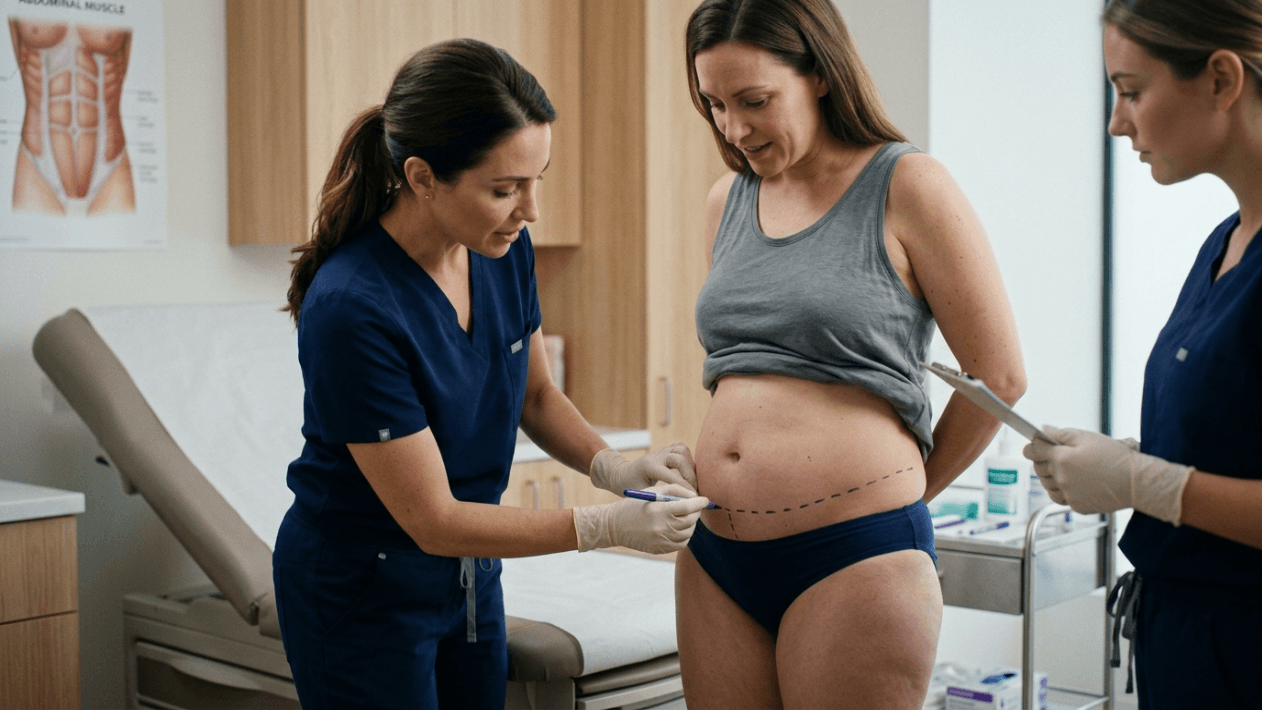
No two tummy tucks share identical recovery demands. A mini abdominoplasty addresses only infra-umbilical skin without muscle repair. A full abdominoplasty repairs diastasis recti from xiphoid to pubis. An HD tummy tuck adds liposuction sculpting to the anterior abdomen and flanks, extending tissue trauma. A fleur-de-lis abdominoplasty introduces a vertical midline incision, doubling suture lines and increasing wound-depth complexity. Each subtype demands a distinct tummy tuck recovery timeline.
Evidence-Based Activity Clearance Table
The table below reflects Dr. Sibel Atalay’s clinical protocol, cross-referenced with 2026 ASPS recovery benchmarks. Times represent the earliest safe initiation point—provided the patient passes a physical clearance examination.
| Activity | Mini Tummy Tuck | Full Tummy Tuck | HD Tummy Tuck | Fleur-de-Lis |
|---|---|---|---|---|
| Driving (no narcotics) | 10–14 days | 14–21 days | 14–21 days | 21–28 days |
| Sexual Activity | 2–3 weeks | 3–4 weeks | 4–5 weeks | 5–6 weeks |
| Swimming (pool/ocean) | 4–6 weeks | 6–8 weeks | 8–10 weeks | 10–12 weeks |
| Flying (commercial) | 7–10 days | 10–14 days | 14–21 days | 21–28 days |
| Weightlifting (light) | 4–6 weeks | 6–8 weeks | 8–10 weeks | 10–12 weeks |
| Weightlifting (heavy) | 8–10 weeks | 10–12 weeks | 12–16 weeks | 16–20 weeks |
Notice the exponential increase between mini and fleur-de-lis timelines. Dual-incision procedures double the sutured tissue planes, and healing follows geometric—not linear—progression. Patients who ignore this pattern risk wound dehiscence, a complication requiring surgical revision under general anesthesia.

Swimming After Abdominoplasty: Bacteria, Pressure, and Suture Integrity
Patients consistently underestimate swimming risks after a tummy tuck. The concern extends far beyond water immersion. Pools, hot tubs, lakes, and oceans harbor bacterial colonies—Pseudomonas aeruginosa in chlorinated pools, Vibrio species in seawater, and atypical mycobacteria in warm spa water. An open incision, even a microscopically patent one, creates a direct conduit for bacteria into the subcutaneous tissue plane where your surgeon just completed dissection.
Why the Water Can Wait
Hydrostatic pressure at a depth of one meter exerts approximately 73 mmHg on the abdominal wall—more than arterial capillary pressure. This pressure stresses freshly repaired fascial sutures before they achieve adequate tensile strength. A 2026 clinical review documented that submersion before week six post-operatively increased seroma formation by 38% and superficial wound dehiscence by 22%. Dr. Atalay’s protocol mandates complete epithelialization confirmed under clinical examination, plus a minimum of six weeks for full abdominoplasty patients, before any submersion occurs.
For HD and fleur-de-lis subtypes, the timeline extends further. Liposuction-treated areas remain edematous and vulnerable to pressure differentials for 8 to 12 weeks. The vertical incision in a fleur-de-lis procedure creates a tension intersection at the T-junction where horizontal and vertical suture lines meet—the single highest-risk point for dehiscence in all abdominoplasty variants.
Swimming Clearance Progression
- Weeks 1–4: No water exposure beyond brief showering. Keep incisions dry between showers.
- Weeks 4–6 (mini only): Shower without restrictions. Bathtub immersion permitted if incisions fully closed.
- Weeks 6–8 (full): Pool swimming permitted after clinical clearance. Avoid ocean and lake water.
- Weeks 8–12 (HD/fleur-de-lis): All water activities cleared, including ocean swimming, once examined.

Flying After Abdominoplasty: The Medical Tourism Patient’s Dilemma
Flying after abdominoplasty introduces three distinct physiological threats: venous thromboembolism risk from prolonged immobility, barometric pressure changes that cause tissue gas expansion, and cabin humidity levels below 20% that dehydrate healing tissue. For medical tourism patients recovering in Antalya—thousands of kilometers from home—the question of when to board a return flight ranks as the single most asked inquiry during post-operative consultations.
Antalya Post-Surgical Travel: Dr. Atalay’s Flight Clearance Protocol
Dr. Sibel Atalay’s clinic in Antalya serves a large international patient population. Her flight clearance protocol accounts for both surgical variables and travel-specific risks. She mandates a minimum 10-day stay in Antalya following a full abdominoplasty before any commercial flight—a timeline grounded in venous thromboembolism data. The World Health Organization attributes 25% of venous thromboembolism cases to travel-related immobility, and post-surgical patients face an elevated baseline risk due to surgery-induced hypercoagulability.
The protocol works as follows. For mini abdominoplasty patients, Dr. Atalay clears flights at day 7 to 10, provided ambulation exceeds 30 minutes without assistance and no narcotics remain in the system. Full abdominoplasty patients require 10 to 14 days of monitored recovery with documented drain removal and confirmed seroma-free status via clinical examination. HD abdominoplasty extends this to 14 to 21 days because the additional liposuction surface area increases inflammatory response and fluid shifts. Fleur-de-lis patients need 21 to 28 days before flying, reflecting the higher wound-complexity burden.
Practical In-Flight Precautions After Clearance
- Wear prescription compression garments throughout the flight duration.
- Walk the aisle every 60 to 90 minutes to maintain venous return.
- Perform seated ankle pumps and calf squeezes every 30 minutes.
- Hydrate aggressively: consume 250 ml of water per hour of flight time.
- Request an aisle seat near the lavatory for independence.
Patients traveling from Antalya benefit from Dr. Atalay’s VIP transfer service linking the clinic, hotel, and airport. This eliminates physical strain from navigating unfamiliar transit systems during the vulnerable early recovery window. You can learn more about the full care pathway at the clinic’s certifications and standards page.

Exercise After Abdominoplasty: Weightlifting, Cardio, and Core Work
Exercise after abdominoplasty follows a non-negotiable biological principle: repaired muscle fascia achieves 30% of its original tensile strength at 3 weeks, 60% at 6 weeks, and 80% at 12 weeks. No amount of determination accelerates collagen cross-linking. Patients who lift weights, perform planks, or engage in rotational core exercises before tissue maturity risk diastasis recurrence—a reversal of the very surgical result they invested in.
The Weightlifting Gradient
Light weightlifting—defined as loads under five kilograms—begins at 4 to 6 weeks for mini abdominoplasty, 6 to 8 weeks for full, 8 to 10 weeks for HD, and 10 to 12 weeks for fleur-de-lis. Heavy weightlifting—loads exceeding five kilograms or any exercise that generates Valsalva intrabdominal pressure—demands 8 to 10 weeks minimum for mini and up to 20 weeks for fleur-de-lis. The Valsalva maneuver, that breath-holding pattern athletes use during heavy lifts, spikes intrabdominal pressure above 150 mmHg. That pressure loads every suture line in your repaired abdominal wall.
Cardio and Core: A Graduated Approach
Walking constitutes the only sanctioned cardiovascular activity for the first two weeks. Dr. Atalay prescribes 5-to-10-minute walks beginning on post-operative day one to prevent venous stasis and stimulate peristalsis. By week three, patients advance to 20-minute flat-surface walks. Stationary cycling enters the protocol at week 4 for mini patients and week 6 for full patients, provided seat height prevents abdominal flexion beyond 45 degrees. Running, jumping, and any plyometric activity remain prohibited until week 8 minimum across all subtypes.
Core-specific exercises—planks, sit-ups, Russian twists, hanging leg raises—require the longest restriction. Dr. Atalay’s protocol prohibits targeted core activation for 12 weeks following full abdominoplasty and 16 weeks following fleur-de-lis. The plication sutures anchoring your repaired rectus abdominis need this time to integrate with surrounding tissue. Premature loading disrupts the repair and invites diastasis recurrence, the very condition the surgery corrected. Every activity-return decision flows through the tummy tuck recovery timeline—no exceptions.

Driving After Tummy Tuck: The Narcotic Threshold and Reflex Test
Most patients ask about driving return within the first week. The answer hinges on two measurable criteria: narcotic clearance and emergency brake-response capability. Operating a vehicle while taking prescription opioids violates driving laws in most jurisdictions and impairs reaction time by 40% or more. Beyond medication, the physical act of turning to check blind spots, braking suddenly, or absorbing the jolt of a speed bump stresses abdominal incisions directly.
Dr. Atalay applies a simple but rigorous driving-clearance test. First, the patient must be off all opioid medications for a minimum of 72 hours. Second, the patient must demonstrate the ability to slam a foot on an imaginary brake pedal within 0.75 seconds without wincing, guarding, or losing abdominal control. Third, the patient must rotate the torso sufficiently to check rear and side blind spots without pain. Mini abdominoplasty patients typically pass this evaluation by day 10 to 14. Full abdominoplasty patients reach this milestone between day 14 and 21. Fleur-de-lis patients require 21 to 28 days given the vertical incision’s impact on rotational mobility.

Sexual Activity After Abdominoplasty: Heart Rate, Tension, and Healing
Cardiovascular exertion during sexual activity raises heart rate above 130 beats per minute and systolic blood pressure above 150 mmHg—physiological parameters that stress fresh incisions and recently repaired muscle plication. Dr. Atalay’s protocol classifies sexual activity return alongside moderate cardiovascular exercise, placing clearance at 2 to 3 weeks for mini patients, 3 to 4 weeks for full abdominoplasty, 4 to 5 weeks for HD, and 5 to 6 weeks for fleur-de-lis.
Several clinical nuances matter here. Post-operative swelling increases intra-abdominal pressure, making even gentle activity uncomfortable during the first two weeks. Orgasm triggers involuntary core-muscle contraction, which directly loads plication sutures. Patients must avoid any position that places the partner’s weight on the abdomen for a minimum of six weeks following a full abdominoplasty. Dr. Atalay advises patients to select positions that prevent direct abdominal compression and to stop immediately if pain exceeds a 3 out of 10 threshold.
How Abdominoplasty Subtypes Shape Tissue Healing and Recovery Demands
Understanding why timelines diverge so dramatically across subtypes requires examining what each procedure does at the tissue level. A mini abdominoplasty involves a supra-pubic skin excision limited to tissue below the umbilicus. No umbilical transposition occurs. No muscle repair occurs. The surgical plane remains superficial, leaving deep fascia undisturbed. Healing follows skin-breakdown timelines: 10 to 14 days for epithelialization, 4 to 6 weeks for full scar maturation at the incision line.
A full abdominoplasty introduces two transformative elements: umbilical transposition and rectus plication. The surgeon frees the umbilicus from its dermal stalk, repairs diastasis recti with running sutures from xiphoid to pubic symphysis, and repositions the umbilicus through a new skin opening. This triple-intervention technique dramatically increases tissue dissection, dead space, and inflammatory burden. Drains typically remain for 7 to 14 days, and seroma risk persists through week 6.
HD abdominoplasty builds on the full procedure by adding liposuction to the epigastric region, flanks, and sometimes the mons pubis. The additional suction trauma creates extensive subdermal tissue tunnels that fill with inflammatory fluid. Compression garments become mandatory for 6 to 8 weeks, and the additional surface area of injured tissue delays healing by approximately two weeks compared to a standard full abdominoplasty.
The fleur-de-lis variant adds a vertical midline excision to the standard horizontal incision, creating an inverted T-shaped closure. This design removes excess skin both horizontally and vertically—critical for patients who have lost 50 or more kilograms. However, the T-junction where three suture lines converge represents the highest-risk point for wound breakdown in all of body contouring surgery. Tension at this intersection remains elevated for 10 to 12 weeks, making any activity that increases intra-abdominal pressure hazardous during that entire window.

Medical Tourism Return-to-Activity: Antalya-Specific Protocols
Patients who travel to Antalya for abdominoplasty face a unique recovery environment. The Mediterranean climate encourages outdoor activity, hotel pools tempt early immersion, and long-haul flights home introduce thromboembolic risk. Dr. Atalay’s clinic protocols address each of these tourism-specific variables with structured guidelines.
The 14-Day Antalya Recovery Window
For full abdominoplasty patients, Dr. Atalay recommends a minimum 14-day stay in Antalya. The first 5 days focus on monitored in-clinic recovery with daily wound checks and drain management. Days 6 through 10 shift to hotel-based recovery with nurse visits. Days 11 through 14 introduce assisted walking along flat surfaces and a formal flight-readiness assessment. This graduated model allows the inflammatory phase to peak and begin resolving before the patient encounters the circulatory challenges of air travel.
Patients recovering from HD or fleur-de-lis abdominoplasty should plan a 21 to 28 day stay. The additional liposuction tissue tunnels in HD procedures produce inflammatory fluid volumes twice that of a standard full abdominoplasty. Fleur-de-lis patients face the T-junction vulnerability window, requiring close monitoring by the surgical team during weeks two and three when wound tension peaks. Attempting a long-haul flight during this window without documented clinical clearance invites preventable complications.
Planning Your Trip Home from Antalya
- Schedule your post-operative examination for 48 hours before departure.
- Obtain written flight clearance from Dr. Atalay confirming seroma-free and wound-intact status.
- Arrange VIP airport transfer to eliminate luggage handling and prolonged standing.
- Pack prescription anticoagulants if indicated by your risk profile.
- Request wheelchair assistance at check-in to reduce walking distance through terminal corridors.

Your Step-by-Step Activity-Graduation Checklist
Print or save this checklist. Each milestone requires clinical confirmation before advancement. Do not self-clear activities based on how you feel—internal healing rarely matches perceived recovery.
- Acknowledge week-zero restrictions: Rest, walk 5 minutes every 2 hours, keep incisions dry, wear compression garment 24 hours per day. Take medications exactly as prescribed.
- Clear narcotic dependency before driving: Stop opioids for 72 consecutive hours, then perform the brake-response and blind-spot rotation test. Document the date you passed.
- Graduate-cardiovascular walking progression: Advance from 5-minute assisted walks in week 1 to 20-minute independent walks in week 3. Record distance and pain levels daily.
- Obtain clinical swimming clearance: Schedule an examination at the minimum week threshold for your subtype. Confirm epithelial closure, seroma absence, and drain-site healing before any water submersion.
- Secure flight-readiness documentation: Complete Dr. Atalay’s travel-clearance examination 48 hours pre-departure. Receive written confirmation of wound integrity and thromboprophylaxis instructions.
- Re-introduce weightlifting through the gradient: Begin with loads under five kilograms at your subtype-specific week threshold. Add two kilograms per week. Avoid Valsalva until week 12 for full abdominoplasty and week 16 for fleur-de-lis.
- Book your six-month outcome assessment: Scar maturation, final contour evaluation, and activity audit confirm your full tummy tuck recovery timeline completion.
Your recovery transforms your body—protect that transformation with discipline and clinical guidance. Dr. Sibel Atalay and her team offer the structured, evidence-based follow-up that global patients require. Schedule your personalized consultation to receive an activity-return plan tailored to your specific abdominoplasty subtype and health profile.
Frequently Asked Questions About Activity Return After Tummy Tuck
How soon can I swim in a pool after a full tummy tuck?
Most patients receive swimming clearance at 6 to 8 weeks following a full abdominoplasty, once incisions fully epithelialize and a clinical examination confirms seroma-free healing. Submersion before this window introduces bacteria into fresh tissue planes and risks wound dehiscence.
Why must medical tourism patients wait before flying from Antalya?
Flying within 10 days of abdominoplasty triples venous thromboembolism risk. Prolonged sitting, cabin pressure changes, and dehydration stress healing tissue. Dr. Atalay’s protocol requires minimum 10 days for full abdominoplasty and 21 days for fleur-de-lis before commercial flights.
When can I lift weights after a fleur-de-lis tummy tuck?
Light weights under five kilograms may begin at 10 to 12 weeks. Heavy weightlifting and any Valsalva-generating exercises require 16 to 20 weeks minimum. The vertical incision’s T-junction remains vulnerable to tension throughout this window.
Can I drive myself home after a tummy tuck?
No patient should drive within the first week. You must be off opioid medications for 72 hours and pass both a brake-response test and full blind-spot rotation check without pain. Mini patients typically reach this at 10 to 14 days; full patients at 14 to 21 days.
How does the HD tummy tuck recovery differ from a standard full tummy tuck?
HD abdominoplasty adds liposuction to the anterior abdomen and flanks, creating additional tissue tunnels prone to fluid accumulation. This extends swimming, flying, and weightlifting clearances by approximately two weeks compared to a standard full abdominoplasty.
What happens if I resume activity too early after abdominoplasty?
Premature activity triggers wound dehiscence, seroma formation, diastasis recurrence, and deep vein thrombosis. Clinical data attributes 67% of preventable post-abdominoplasty complications to patients resuming activities before tissue healing reaches adequate tensile strength.