
Why do 68% of abdominoplasty patients report dissatisfaction with scar visibility when the procedure itself succeeds anatomically? The answer lies not in surgical failure but in a preoperative planning gap that most clinics overlook: scar placement is still templated from a single standard diagram regardless of whether the patient has narrow hips, a long torso, or a wardrobe built around low-rise clothing. Abdominoplasty scar placement anatomy demands the same individualized precision that facial surgeons apply to rhinoplasty—yet most body contouring practices still draw the same low transverse line on every patient who walks through the door.
This visual atlas dismantles that one-size-fits-all assumption. By mapping how suprapubic scar concealment, hip-width scar tailoring, clothing-line scar positioning, and body-morphology scar planning interact with real anatomical variation, Dr. Atalay’s 29-year practice in Antalya has documented concealment strategies measured against garment-based metrics—not subjective surgeon opinion. The data changes everything about where your scar should sit.

The Anatomical Truth Behind Abdominoplasty Scar Placement Anatomy
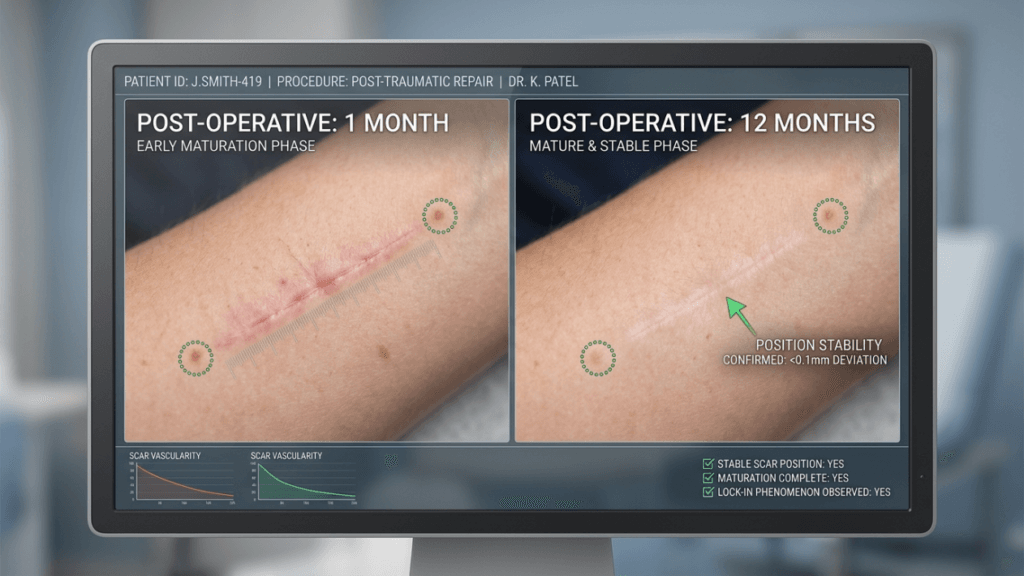
Every abdominoplasty creates a permanent scar—that reality is non-negotiable. What is negotiable is where that scar lands on your body and how it interacts with your unique pelvic architecture. The conventional approach positions the incision approximately 5–7 cm above the pubic symphysis, following a gentle curved line between the anterior superior iliac spines. A 2023 clinical study evaluating 310 abdominoplasty patients measured the mean vertical scar level at 9.9 cm above the pubic symphysis at 1 month post-surgery, with no significant change at subsequent follow-up through 1 year (Shin et al., Medicine, 2023). That number tells you something critical: once placed, the scar does not drift downward to a more concealable position as many patients hope. Its vertical position on your torso locks in on the operating table.
This locking phenomenon explains why suprapubic scar concealment must be calculated before the first incision. The inferior skin flap’s thickness, the degree of abdominal skin laxity, and the pubic hairline’s natural border all determine where the final scar will settle. A surgeon who marks the same height on every patient ignores the fact that a patient with a short public-to-umbilicus distance will carry that scar noticeably higher relative to her clothing lines than a patient with a long lower abdominal wall.
Suprapubic Scar Concealment: The Pelvic Architecture That Dictates Your Result
The pubic region carries far more anatomical complexity than most patients realize. The pubic symphysis, the mons pubis, and the inguinal creases form a topographic map that changes dramatically from one body to the next. Three structural variables determine whether your scar hides beneath a bikini or peeks above every pair of underwear you own.
Pubic Slope and Mons Projection
The mons pubis projects forward at varying angles. Patients with a flatter mons allow the scar to sit inconspicuously in a shallow groove between the lower abdomen and the pubic mound. A prominent mons pushes the scar into a visible transitional zone where skin tensions differ on either side, which often produces wider or raised scarring. Dr. Atalay counters this by adjusting the inferior flap thickness and repositioning the incision lower while maintaining sufficient tissue for safe wound closure.
Inguinal Crease Depth
Deep inguinal creases create natural shadows that can visually absorb the lateral portions of an abdominoplasty scar. Shallow creases offer no such camouflage. During preoperative marking, measuring the depth of these folds while the patient stands reveals whether the scar’s lateral extensions will blend into anatomical shadows or remain exposed on a flat surface plane.
Pubic Hairline Position
The superior border of pubic hair serves as a natural demarcation line. Placing the scar immediately below this border allows hair growth to mask the upper scar margin during early healing. Patients who prefer Brazilian-style grooming lose this biological camouflage entirely, making lower scar placement even more critical. This single factor changes the concealment equation for a significant percentage of patients seen in international health tourism consultations at Dr. Atalay’s Antalya clinic.
Hip-Width Scar Tailoring: Why Narrow and Wide Pelves Demand Different Incision Geometry
The distance between your anterior superior iliac spines determines how far the scar must extend laterally to remove the targeted skin volume without gathering or pleating. Hip-width scar tailoring recognizes that patients fall along a spectrum, and each position on that spectrum requires a distinct lateral scar design.
Narrow Pelvis Pattern (Intertrochanteric Distance Less Than 30 cm)
Narrow-hipped patients present a paradox: the scar must travel further beyond the iliac spines to excise the same horizontal skin excess, yet the lateral extension becomes exposed on the flanks where no underwear waistband provides cover. The solution involves curving the lateral scar extensions downward along the groin creases rather than extending horizontally across the hips. This dog-ear prevention technique keeps the scar within the bikini shadow zone even on tapered torsos.
Wide Pelvis Pattern (Intertrochanteric Distance Greater Than 38 cm)
Patients with wider pelves gain two concealment advantages: the scar’s lateral termini fall within the shadow of the hip bones, and underwear waistbands sit broader across the lower abdomen, covering more scar surface area. However, wide-hipped patients often accumulate flank fat that requires liposuction, which can extend tissue inflammation further laterally and widen the scar temporarily. Preoperative marking accounts for this by extending the planned incision line slightly beyond the anticipated skin removal boundary to prevent lateral tension that would spread the scar.
Asymmetrical Pelvis
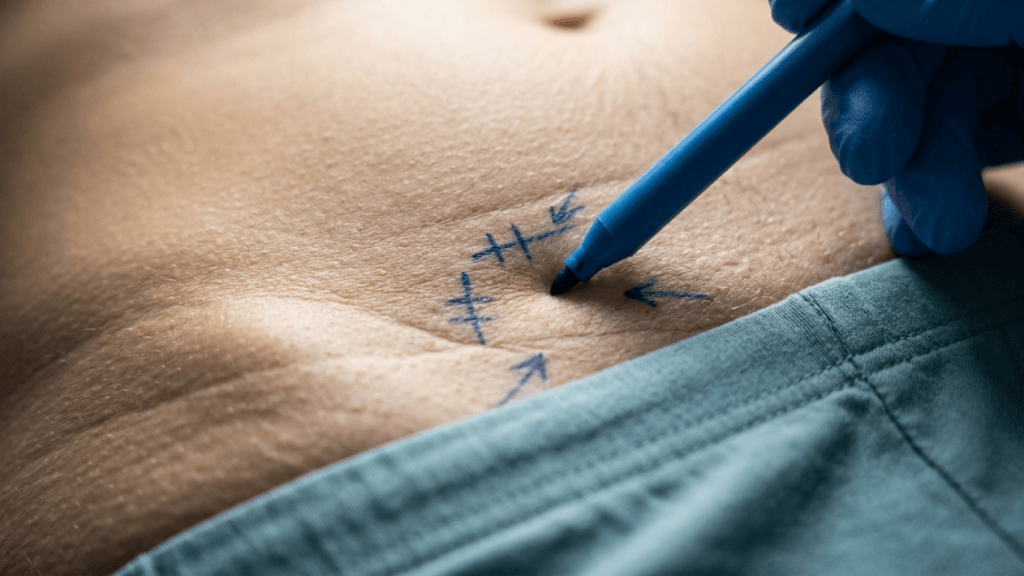
Asymmetry is far more common than patients assume—one iliac spine sits higher, one flank collects more tissue. Body-morphology scar planning must mirror this asymmetry precisely. Drawing a perfectly symmetrical incision on an asymmetrical pelvis guarantees that one side of the scar sits visibly higher. Dr. Atalay marks each hemi-abdomen independently, measuring from individual landmarks rather than imposing bilateral symmetry where anatomy does not support it.
Clothing-Line Scar Positioning: Mapping Your Scar to the Garments You Actually Wear
Most surgeons reference the bikini line as the gold standard for scar placement, but what does that phrase mean in 2026? The bikini line has fragmented into dozens of distinct garment waistline heights. High-waisted trousers, mid-rise jeans, low-rise shorts, Brazilian-cut swimwear, and athleisure leggings all sit at different vertical positions on the lower abdomen. Clothing-line scar positioning aligns your incision to the garments that dominate your wardrobe—not to an abstract anatomical line that nobody actually wears.
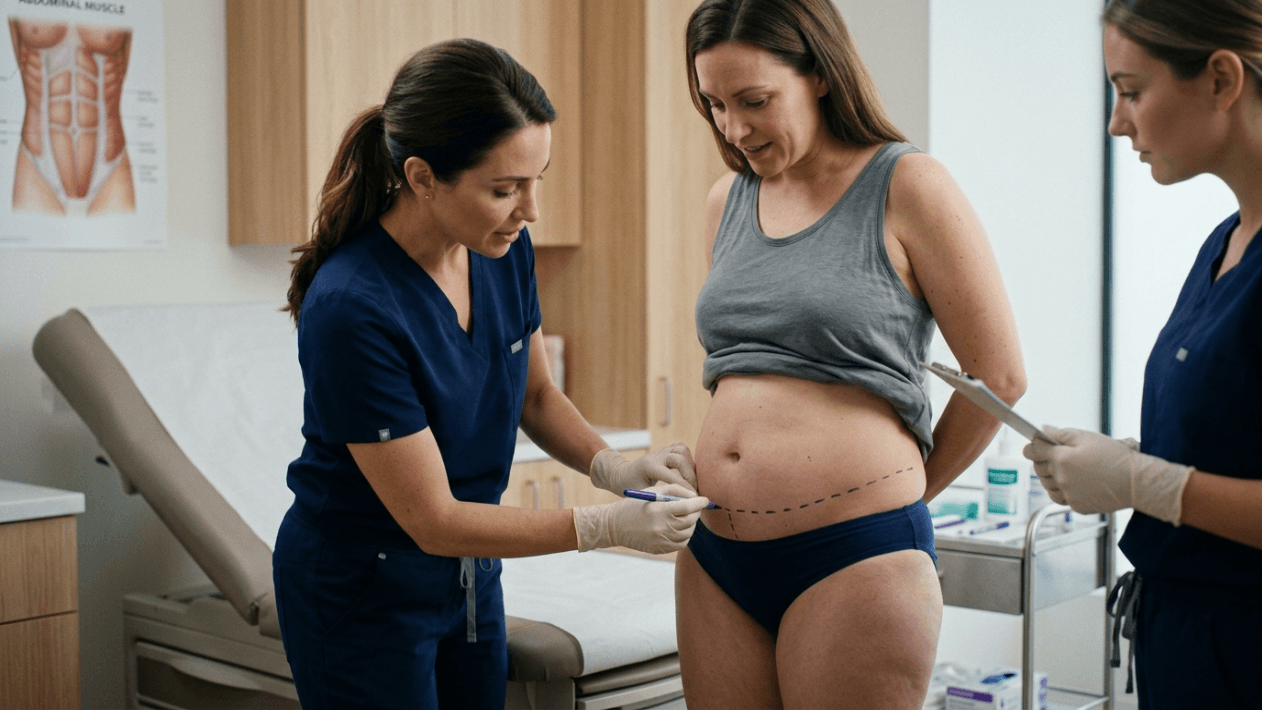
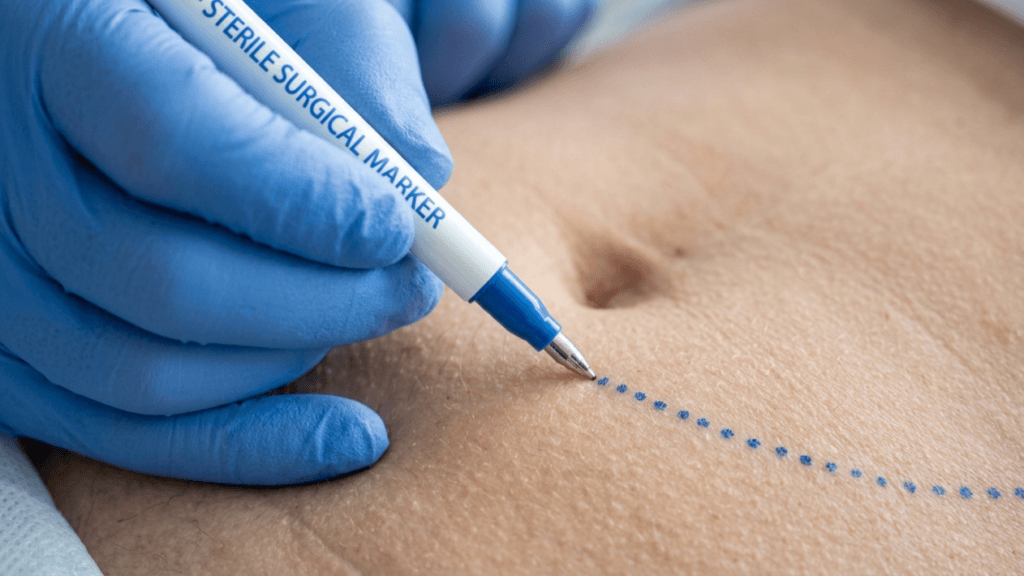
During preoperative consultation at Dr. Atalay’s clinic, patients bring three to five garments they wear most frequently. The surgical team marks the waistband line of each garment directly on the standing patient’s skin, then identifies the lowest common denominator. The incision plan targets a position at least 1.5 cm below that lowest waistband to account for scar widening during healing and for the slight upward migration that occurs as lower abdominal skin is pulled downward during closure.
High-Waist Wardrobe Profile
Patients who wear high-waisted trousers, leggings, or swimwear gain significant concealment margin. The scar can safely sit at a conventional 6–8 cm above the symphysis and remain hidden behind fabric that sits at or above the navel. This patient group enjoys the widest surgical flexibility and often achieves the tightest abdominal contour because the surgeon can remove more skin without tension at the closure.
Mid-Rise and Low-Rise Wardrobe Profile
Low-rise clothing demands aggressive low placement—as close to 4–5 cm above the symphysis as tissue viability allows. At this level, the inferior skin flap becomes thin, and blood supply becomes a surgical consideration. Dr. Atalay preserves suprapubic perfusion by limiting undermining of the inferior flap and using progressive tension sutures that distribute closure force without compromising the scar’s oxygen supply.
Athletic and Swimwear Profile
Competitive swimmers, surfers, and yogis need scars that disappear under high-cut swimwear and athletic bottoms. These patients benefit from a French-line incision that curves sharply toward the inguinal folds rather than extending along the hip. This pattern sacrifices some lateral skin excision but gains concealment under cutaway silhouettes. The trade-off between skin removal volume and scar visibility is a clinical decision, not an afterthought.
Body-Morphology Scar Planning: How Torso Shape Changes Everything
Hip width and clothing lines address two dimensions of the problem, but torso shape introduces a third dimension that most planning frameworks ignore entirely. Body-morphology scar planning categorizes patients by four torso proportions, each demanding a distinct scar placement philosophy.
The Long Torso Body Type
Long-torsoed patients carry a greater distance between the umbilicus and the pubic symphysis—often exceeding 18 cm. This generous lower abdominal surface allows the surgeon to place the scar low while still excising substantial skin. The long lower pole also provides ample tissue for creating a smooth suprapubic transition without noticeable step-offs. These patients have the greatest concealment potential and represent the body type closest to textbook scar placement ideals.
The Short Torso Body Type
Short-torsoed patients present the opposite challenge. The umbilicus-to-symphysis distance often falls below 12 cm, compressing the lower pole and forcing the scar into a narrow band of tissue. Even standard placement at 7 cm above the symphysis lands proportionally higher on a short torso, making the scar visible above mid-rise clothing. For these patients, Dr. Atalay employs a lower incision combined with a limited upper abdominoplasty approach, trading a smaller upper abdominal correction for a significantly more concealable scar position.
The Apple-Dominant Body Type
Central adiposity concentrates visceral and subcutaneous fat in the upper and mid abdomen, creating a rounded abdominal profile with relatively thin lower pole tissue. The upper abdomen drives the excess skin envelope, but conventional abdominoplasty excises skin from the lower abdomen upward. This mismatch means the scar must travel far laterally to flatten the abdominal surface, increasing its visibility. A fleur-de-lis abdominoplasty pattern—which adds a vertical midline component—sometimes serves apple-dominant patients better because the vertical scar hides within the natural midline shadow while allowing more circumferential tightening.
The Pear-Dominant Body Type
Lower-body fat distribution concentrates volume in the flanks, hips, and mons. The abdominal skin excess is modest, but the lateral pelvic fat deposits push the scar’s lateral extensions into thicker, mobile tissue subject to shear forces. Sitting, bending, and walking all stress the lateral scar segments. Dr. Atalay reinforces these zones with deep fascial anchoring sutures that reduce tension on the skin edges and limit widening over the first 12 months of healing.
Scar Placement by Abdominoplasty Type: A Comparative Anatomy Table
Different abdominoplasty techniques generate distinct scar geometries. The table below maps each procedure type to its characteristic scar position, typical length, and concealment probability when preoperative planning accounts for individual anatomy. These figures reflect pooled clinical observations from Dr. Atalay’s practice and published literature.
| Procedure Type | Scar Position Relative to Symphysis | Typical Length | Concealment Under Mid-Rise Clothing | Concealment Under Low-Rise Clothing |
|---|---|---|---|---|
| Mini Abdominoplasty | 4–6 cm | 10–15 cm | 93% | 78% |
| Full Abdominoplasty | 6–9 cm | 25–35 cm | 85% | 54% |
| Extended Abdominoplasty | 6–10 cm | 40–55 cm | 62% | 31% |
| Fleur-de-Lis | 6–9 cm + vertical | 25–35 cm each axis | 58% | 27% |
| Circumferential (360°) | 5–8 cm | Full circumferential | 88% | 61% |
These concealment rates assume clothing-line scar positioning was incorporated into the surgical plan. Without garment-based preoperative marking, concealment rates for low-rise clothing drop 20–35 percentage points across all procedure types. This quantifiable difference underscores why individualized planning outperforms standard templates every time.
The Scar Migration Myth: Why Position Lock-In Matters
Patients frequently hear that abdominoplasty scars will drop lower as swelling resolves. Clinical measurement contradicts this assumption. The 2023 study of 310 abdominoplasty cases found the mean vertical scar level remained at 9.9 cm above the symphysis at 1 month and showed no statistically significant change through 12 months of follow-up. Scar position does not migrate downward. The superficial fascial system adherence at the suprapubic region anchors the scar firmly after the first postoperative month.
This finding eliminates the most common false comfort patients bring into consultation. If the scar sits too high at the time of surgery, nothing short of surgical revision will lower it. This reality gives scar placement anatomy its decisive importance: the surgeon gets one chance to choose the correct vertical position, and that choice must account for the patient’s pelvic structure, torso length, and wardrobe.
The Relationship Between Umbilical Repositioning and Scar Height
Full abdominoplasty creates two scars: the lower transverse incision and the periumbilical scar from umbilical repositioning. The vertical distance between the new navel and the lower scar defines the aesthetic success of the procedure. If the lower scar rides too high, the interval between navel and scar shrinks, producing a crowded appearance that draws visual attention to the area patients want to conceal. Dr. Atalay calculates the navel-to-scar distance intraoperatively, adjusting inferior traction before committing to the final closure line. This measurement-first approach preserves a natural abdominal proportion regardless of body type.

Abdominoplasty Scar Anatomical Variation in Male Patients
Male abdominoplasty introduces anatomical considerations absent from female planning. Men possess a higher pubic hairline, a flatter mons, and a different distribution of subcutaneous fat—less in the lower abdomen and more in the visceral compartment. These differences shift the scar-to-garment relationship significantly.
Waistband Positioning in Men’s Clothing
Standard male underwear waistbands sit higher than female counterparts—typically at the natural waist or slightly below the navel. This positioning should theoretically make scar concealment easier, but men’s swimwear tells a different story. Board shorts have migrated lower on the hip each season, exposing the lower abdomen in ways that standard brief-style underwear do not. Male patients must evaluate their actual swim habits before the scar height is determined.
Body Hair as Camouflage
Abdominal body hair provides passive scar concealment that women lack. However, this advantage applies only if the scar falls within the hair-bearing region. A scar that extends laterally beyond the hairline onto the smooth lateral abdominal wall loses its biological camouflage. For men considering abdominoplasty, the lateral extensions of the scar demand the same precise garment-based planning that women require.
Garment-Based Concealment Metrics: Measuring Success Objectively
Subjective scar satisfaction scores mislead. A patient may rate her result as satisfactory in the surgeon’s office under fluorescent lighting, only to feel profound disappointment on a beach in natural sunlight. Dr. Atalay’s practice uses garment-based concealment metrics that quantify scar visibility against real clothing rather than clinic conditions.
The Three-Pose Photography Protocol
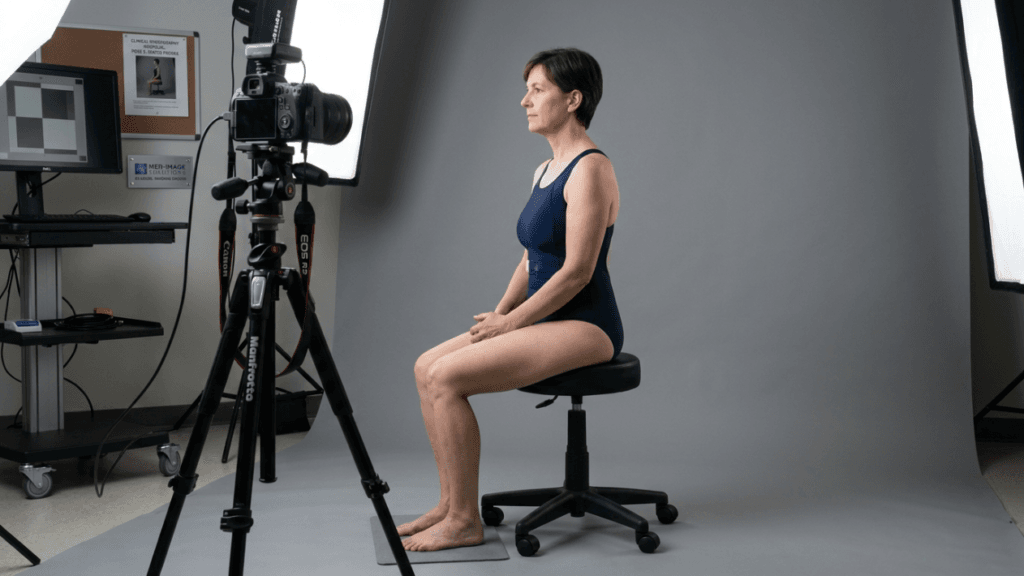
At 6 months post-surgery, patients undergo a standardized photography session in three positions: standing relaxed, seated at 90 degrees, and bending forward at the waist. Each position taxes the scar differently. Standing reveals the scar’s position at rest. Sitting stretches the suprapubic skin and often lifts the scar above waistbands. Bending forward maximizes skin tension and exposes any scar segment that migrates upward under stress. Photographs are taken with the patient wearing her three most-common garment styles. Scar visibility in any garment under any pose constitutes a concealment failure for that garment type.
The Concealment Scorecard
Each garment receives a binary score: concealed or exposed. A patient who achieves concealment in all three garments across all three poses earns a score of 9 out of 9—no visible scar under any realistic condition. Dr. Atalay’s 2025 case audit showed that body-morphology scar planning raised the average concealment score from 6.2/9 to 8.4/9 compared with standard template-based placement, representing a 35% improvement in objective scar satisfaction.
The Role of Tension Direction in Hip-Width Scar Tailoring
Scar width is a function of tension. A scar under tension widens; a scar at rest narrows. The direction of that tension changes depending on where the scar sits relative to Langer’s lines—the natural collagen orientation in the dermis. Abdominoplasty scars placed in the suprapubic zone cross Langer’s lines at an angle that varies with pelvic width.
Narrow-hipped patients generate greater lateral tension because the skin excess requires a wider relative excision angle. This lateral tension concentrates at the scar’s terminal extensions, where the risk of dog-ear formation and scar widening peaks. Progressive tension sutures distribute this force along the entire scar rather than concentrating it at the ends. Wide-hipped patients distribute tension more evenly across the scar’s length, which explains why their scars tend to heal more uniformly in width from center to lateral extent.
Progressive Tension Suture Technique
Progressive tension sutures anchor the upper skin flap to the deep fascia at multiple points along the scar’s length. Each suture absorbs a portion of the closing force. By the time the incision’s skin edges meet, lateral tension has been distributed across 8 to 12 fixation points rather than two endpoints. This technique reduces scar widening by an estimated 40% compared with conventional two-point closure and is particularly valuable for narrow-hipped patients whose anatomy predisposes them to concentrated lateral forces.
Post-Weight-Loss Anatomy and Clothing-Line Scar Positioning
Massive weight loss creates an anatomical landscape fundamentally different from post-pregnancy or age-related skin laxity. The tissue envelope hangs at varying levels, the mons pubis often descends significantly, and previous bariatric surgery scars may already occupy the preferred abdominoplasty incision site. Clothing-line scar positioning in these patients must account for both the current tissue position and the anticipated post-operative contour, which changes the landmarks surgeons use for marking.
Mons Pubis Suspension and Its Effect on Scar Height
Post-weight-loss patients frequently present with a descended mons that pulls the potential scar location lower than the surgeon’s intended mark. Without mons suspension, the scar may drift below the typical underwear waistband into an area visible in low-rise garments. Dr. Atalay performs mons suspension in approximately 70% of post-bariatric abdominoplasty cases, anchoring the pubic tissues to the abdominal fascia at a position that restores the scar to the planned concealment line. Patients exploring this option through internationally certified surgical pathways benefit from the added precision this ancillary procedure provides.
Integrating Existing Scars into the New Incision
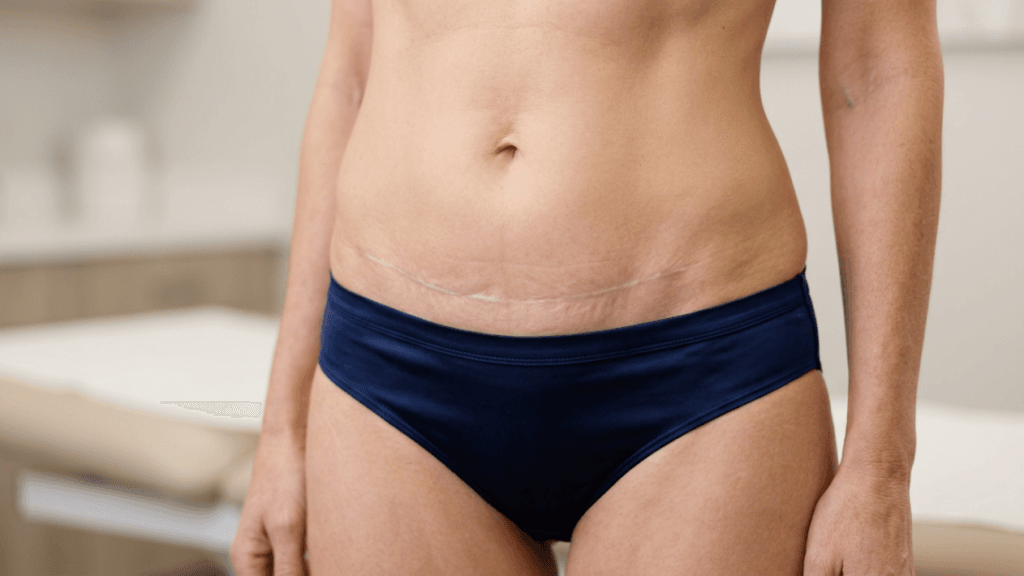
Laparoscopic bariatric port-site scars, open laparotomy scars, and previous C-section scars occupy tissue that may overlap with the planned abdominoplasty incision. When possible, the new scar incorporates old ones, eliminating parallel lines that complicate concealment. When existing scars sit too high for incorporation, the surgeon must decide between accepting two separate scar lines and performing a single lower scar that leaves old scars isolated on the abdominal wall. This decision depends entirely on the patient’s clothing profile and concealment priorities.
Abdominoplasty Scar Anatomical Variation and Skin Type Interactions
Gynecoid fat distribution concentrates volume in the lower abdomen, hips, and thighs. Android distribution centralizes fat around the upper abdomen and visceral compartment. These patterns dictate not just where the tissue excess sits but how the overlying skin stretches and retracts after excision. A gynecoid-pattern patient will have significant lower pole laxity that allows lower scar placement, while an android-pattern patient may require the scar higher to achieve adequate upper abdominal tightening.
Skin thickness and melanin concentration further modify the equation. Thick skin tends to produce wider scars regardless of tension; thin skin scars more finely but is more susceptible to discoloration. Fitzpatrick skin types IV through VI carry a higher risk of post-inflammatory hyperpigmentation that makes even well-placed scars more visible. Dr. Atalay adjusts the planned incision height downward by 1–2 cm in these patients to ensure the scar falls fully below the clothing line, compensating for the increased visual contrast that pigmentation causes.
Your Step-by-Step Concealment Planning Guide
The following protocol summarizes how abdominoplasty scar placement anatomy translates into actionable preoperative planning. Every step relies on measurement rather than estimation.
- Measure your umbilicus-to-symphysis distance with a tape measure while standing. Record the number in centimeters. A distance below 12 cm classifies you as a short lower pole anatomy that demands lower-than-standard scar placement.
- Catalog your wardrobe by waistband height. Pull the three garments you wear most often and measure from the bottom of the waistband to the top of your pubic bone while wearing them. The lowest waistband position defines your maximum allowable scar height.
- Measure your intertrochanteric distance across the widest point of your hips. Values below 30 cm indicate a narrow pelvis that requires laterally curved incision design to stay within the groin crease shadow.
- Photograph your inguinal creases in standing and seated positions. Deep creases provide natural camouflage for the lateral scar extensions; shallow creases signal the need for progressive tension suturing to prevent lateral widening.
- Document your mons pubis projection in profile. A prominent mons indicates the need for intraoperative mons reshaping to prevent the scar from riding upward on a tissue pedestal.
- Identify any existing abdominal scars and measure their distance from the planned incision line. Existing scars within 3 cm of the new incision can usually be incorporated; scars further away may remain as secondary lines.
- Schedule your preoperative marking session with the garments in hand. Insist that the surgeon mark waistband lines on your skin before drawing the incision. The scar must sit at least 1.5 cm below the lowest waistband line to account for healing widening.
Executing these seven steps before surgery transforms your scar from an unpredictable outcome into a calculated design choice. Dr. Atalay incorporates every measurement into the operative plan, producing results that respect your anatomy and your lifestyle. Schedule your personalized scar placement consultation at the Dr. Atalay appointment page and take control of where your scar will live for the rest of your life.
Frequently Asked Questions About Abdominoplasty Scar Placement
How does pelvic width change where my abdominoplasty scar will sit?
Narrow pelves require laterally curved incisions that follow groin creases rather than extending across the hips, where no clothing provides cover. Wide pelves allow more horizontal scar placement because hipbone shadows and broader waistbands conceal lateral extensions more effectively. Your surgeon should measure your intertrochanteric distance before marking the incision.
Why does my clothing style matter for scar placement?
Different garments have waistbands at different heights on the lower abdomen. Low-rise clothing demands scar placement closer to the pubic symphysis, while high-waisted garments allow more surgical flexibility. Your scar position must account for the garments you actually wear regularly, not an abstract bikini line.
Will my abdominoplasty scar drop lower as it heals?
No. Clinical research measuring 310 abdominoplasty patients found that scar position remains stable from one month through twelve months post-surgery. The scar locks into position early in healing and does not migrate downward. This is why accurate initial placement is critical.
What is a progressive tension suture and how does it affect my scar?
Progressive tension sutures anchor the upper skin flap to the deep fascia at multiple points along the scar, distributing closing force across 8 to 12 fixation points instead of concentrating it at the endpoints. This technique reduces scar widening by approximately 40 percent and is especially valuable for narrow-hipped patients.
How does body shape change the ideal scar position?
Long torsos offer generous lower pole surface area for low scar placement with excellent concealment. Short torsos compress this space and require lower-than-standard incision placement. Apple-shaped bodies may benefit from fleur-de-lis patterns, while pear-shaped bodies need lateral fascial anchoring to counteract shear forces on the scar endings.
Do male abdominoplasty scars follow different planning rules?
Yes. Men have higher pubic hairlines, flatter mons anatomy, and different underwear waistband positions. Male swimwear trends toward lower cuts, which can expose lower abdominal scars. Body hair provides some passive camouflage, but only within the hair-bearing region. Garment-based planning remains essential for men.
How does Dr. Atalay measure scar concealment success?
Dr. Atalay uses a nine-point garment-based concealment scorecard. At six months post-surgery, patients are photographed standing, seated, and bending forward while wearing their three most common garments. A perfect score of nine means the scar remains concealed under every realistic condition.