
Did you know that over half of all silicone breast implant ruptures are completely silent? Research published in clinical radiology studies found that 51% of clinically “intact” implants were actually ruptured when examined by MRI — meaning your body can hide a device failure behind zero pain, zero visible change, and zero urgency signals. A breast implant rupture does not always announce itself with dramatic deflation or sudden pain. In most cases, it whispers — or says nothing at all.
This article delivers exactly what panicked searchers need: a clear breakdown of silent versus symptomatic rupture signs by implant type, the step-by-step diagnostic imaging pathway from ultrasound to MRI, an urgency classification framework with surgical timelines, and the concrete reasons why Antalya-based revision surgery offers decisive advantages. By the final section, you will possess an actionable roadmap — not vague reassurance, but a decision-making protocol trusted by a board-certified plastic surgeon with 29 years of experience.

Silent vs. Symptomatic Rupture: Why Your Implant Type Changes Everything
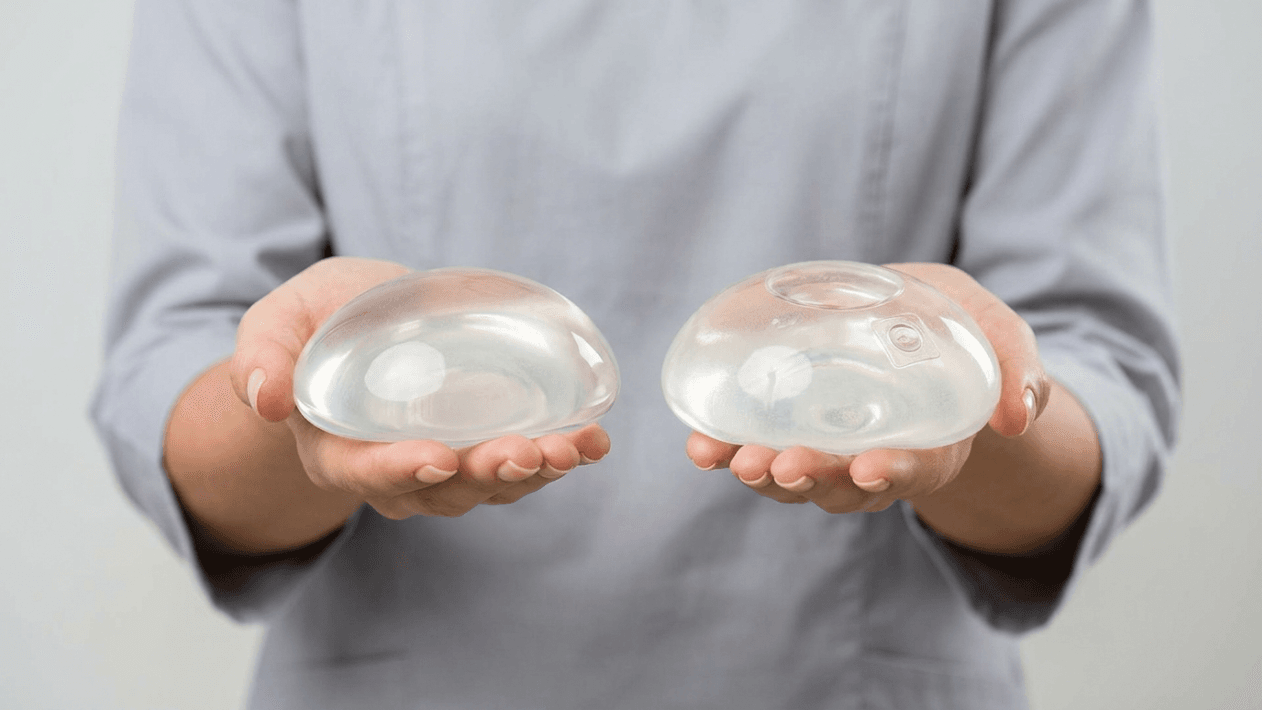
The single most important variable in recognizing a breast implant rupture is the fill material inside your device. Saline and silicone implants fail in fundamentally different ways, and understanding that difference can turn a terrifying unknown into a manageable clinical scenario.
Saline Implant Deflation: The Obvious Failure
Saline implants contain sterile saltwater inside a silicone elastomer shell. When that shell breaches, the fluid escapes rapidly — typically over a few days — and your breast visibly shrinks. The body absorbs the saline without harm. There is no mystery here. You see the volume loss, you feel the softness, and you know something is wrong.
Saline implant deflation produces unmistakable signs: a sudden decrease in breast size, wrinkling or rippling of the overlying skin, and a noticeably softer feel compared to the opposite side. Some patients report a brief swooshing sensation. The psychological shock is real, but the clinical danger is minimal. The saltwater is biocompatible, and your body processes it like any intravenous fluid.
However, the cosmetic urgency remains genuine. A deflated shell can fold upon itself, creating sharp edges that irritate surrounding tissue or even press through thin skin. Leaving a ruptured saline implant in place for extended periods increases the risk of pocket collapse and capsular changes that complicate future revision. According to Breastcancer.org, surgical removal can be delayed if health conditions make immediate surgery unsafe — but the device should not remain indefinitely.
Silent Rupture Silicone: The Invisible Threat
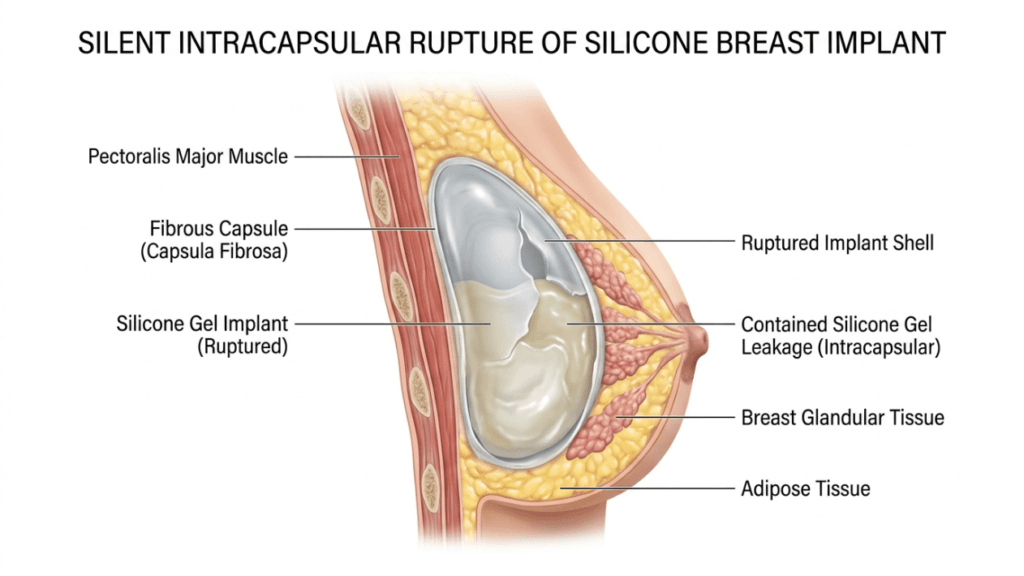
Silicone gel implants present a categorically different challenge. The cohesive gel inside does not flow freely like saline. Instead, it oozes slowly. When the outer shell develops a micro-tear, the thick gel may remain contained within the fibrous capsule your body naturally forms around the device. This is called an intracapsular rupture, and it produces no symptoms in most patients.
A study comparing clinical examination against MRI found that 51% of implants classified as “intact” by physical exam were actually ruptured on imaging. This statistic should alarm every person carrying silicone implants. A silent rupture silicone scenario means you cannot rely on how you feel or how your breast looks to determine device integrity.
When silicone leaks beyond the capsule — an extracapsular rupture — symptoms may emerge. These include gradual changes in breast shape or size, increasing firmness, swelling, and pain developing over weeks rather than hours. Paradoxically, many of these signs overlap with capsular contracture, creating confusion between two distinct complications.
Capsular Contracture vs. Rupture: A Critical Distinction
Patients often contact our clinic convinced they have a ruptured implant when the actual problem is capsular contracture — or vice versa. The confusion is understandable. Both conditions cause breast firmness, both alter shape, and both can generate discomfort. But the treatment paths diverge sharply, and misidentification delays proper care.
Capsular contracture occurs when the scar tissue capsule surrounding your implant thickens and contracts, squeezing the device. The breast becomes firm, may appear rounded or distorted, and can feel tight or painful. The implant itself remains intact inside its contracted prison. A breast implant rupture, on the other hand, involves a breach in the device shell — with or without capsule involvement.
Here is the nuance that most resources miss: capsular contracture can actually be caused by a silent rupture. When silicone gel seeps through a micro-perforation in the shell, the gel irritates the capsule, triggering an inflammatory cascade that thickens and tightens the tissue around it. This means a Grade III or Grade IV capsular contracture appearing years after augmentation should raise suspicion of an underlying rupture, not just scar tissue behavior in isolation.
Distinguishing between isolated contracture and contracture secondary to rupture requires imaging. Physical examination alone cannot reliably separate the two. This is why any presentation of new-onset capsular contracture in a patient with silicone implants warrants diagnostic investigation beyond the clinical exam.

Diagnostic Imaging Pathway: From Ultrasound to MRI
When a breast implant rupture is suspected, imaging becomes the decisive tool. The diagnostic pathway typically follows a two-tier sequence: ultrasound first, then MRI when ultrasound results are inconclusive or when silicone implant integrity must be confirmed with high sensitivity.
Ultrasound: The Accessible First Screen
Breast ultrasound is widely available, radiation-free, and cost-effective. For saline implant deflation, ultrasound serves primarily as confirmation — the diagnosis is already clinical. Your breast has visibly deflated, and ultrasound simply documents the empty shell within the pocket.
For silicone implants, ultrasound can detect signs of rupture, including the stepladder sign — parallel echogenic lines within the implant that represent the collapsed inner shell floating in silicone gel. It can also identify extracapsular silicone as hyperechoic masses or “snowstorm” appearances in surrounding tissue. However, ultrasound sensitivity for intracapsular rupture ranges from 59% to 85%, meaning it misses a significant share of silent ruptures.
Ultrasound excels at identifying conditions that mimic rupture — such as capsular contracture, seromas, or benign cysts — making it an excellent rule-out tool when symptoms are vague. But for definitive confirmation of silicone integrity, it has limitations.
MRI Diagnosis Breast Implant: The Gold Standard
MRI diagnosis breast implant evaluation represents the most accurate non-surgical method available. The American College of Radiology and the American Society of Plastic Surgeons both recognize MRI as the preferred imaging modality for detecting silicone implant rupture, reporting sensitivity between 72% and 94% with specificity from 85% to 100%.
MRI uses silicone-selective and water-selective sequences to isolate the gel from surrounding tissues. The hallmark linguine sign — multiple curvilinear low-signal lines within the implant on T2-weighted images — confirms intracapsular rupture by showing the collapsed shell floating in gel. The keyhole sign and teardrop sign represent earlier stages where silicone has herniated through a focal shell defect but remains partially contained.
Importantly, MRI for breast implant rupture evaluation does not require intravenous contrast. The implant-specific sequences provide sufficient information without gadolinium injection, making the exam simpler and faster than a diagnostic breast MRI for cancer screening. The scan typically takes 20 to 30 minutes in the machine.
The FDA recommends that patients with silicone implants receive their first MRI or ultrasound screening five to six years after implantation, followed by screenings every two years thereafter. This protocol exists precisely because silent rupture is so prevalent — up to 50% of implants may show some degree of shell damage by the ten-year mark.
Comparing Diagnostic Accuracy: Ultrasound vs. MRI
Understanding the numbers behind each imaging modality helps you advocate for the right test. The table below presents comparative diagnostic performance drawn from published clinical data and the American College of Radiology Appropriateness Criteria.
| Parameter | Ultrasound | MRI |
|---|---|---|
| Sensitivity (Intracapsular) | 59%–85% | 72%–94% |
| Specificity | 55%–85% | 85%–100% |
| Extracapsular Rupture Detection | Good (“snowstorm” sign) | Excellent (silicone-selective sequences) |
| Silent Rupture Silicone Detection | Moderate | High |
| Radiation Exposure | None | None |
| Cost (Approximate Range) | $200–$500 | $1,000–$5,000+ |
| Availability | Widely Available | Specialized Center Required |
| Contrast Required | No | No (for implant evaluation) |
| ACR Appropriateness Rating | Usually Appropriate (equivocal cases) | Usually Appropriate (suspected silicone rupture) |
The data reveals a clear pattern: ultrasound works well as a rapid screen and for evaluating symptomatic palpable findings, while MRI delivers the diagnostic certainty needed before committing to surgical revision. In patients with silicone implants, a normal ultrasound does not exclude rupture. A negative ultrasound with persistent clinical suspicion should always be followed by MRI.
Implant Rupture Emergency: Urgency Classification and Surgical Timelines
Not every breast implant rupture demands the same response timeline. Overreaction breeds panic; underreaction breeds complications. An urgency classification system — as used in our clinical protocol at Op. Dr. Sibel Atalay’s practice — sorts ruptures into three tiers based on risk progression and clinical evidence.
Tier 1 — Scheduled Revision (2–4 Weeks)
This tier covers asymptomatic intracapsular rupture discovered during routine screening MRI. The silicone gel remains contained within the fibrous capsule, no extracapsular migration is visible, and the patient experiences no pain, swelling, or lymph node changes. Surgery should be planned within two to four weeks to prevent progression, but there is no life-threatening emergency.
Even though intracapsular rupture feels non-urgent, delaying indefinitely carries risk. The gel inside the capsule can degrade the shell further, eventually breaching the capsule and migrating to lymph nodes. Additionally, chronic intracapsular rupture commonly triggers secondary capsular contracture that complicates the revision procedure and increases tissue damage during explantation.
Tier 2 — Priority Revision (1–2 Weeks)
Extracapsular rupture with localized silicone migration — but without systemic symptoms — falls into this tier. MRI shows silicone gel escaping the capsule into adjacent breast tissue, possibly reaching ipsilateral axillary lymph nodes. The patient may notice increasing firmness, shape distortion, or mild discomfort. Surgical planning should occur within one to two weeks.
The critical variable here is how far the gel has traveled. Localized extracapsular silicone in the breast parenchyma can be removed during en bloc capsulectomy with the implant. However, the longer the gel sits in tissue, the more it provokes granulomatous inflammation — forming silicone granulomas that adhere to surrounding structures and make clean excision progressively harder.
Tier 3 — Urgent Revision (Within Days)
This tier encompasses any rupture accompanied by acute symptoms: significant pain, rapid swelling, skin changes, fever, or signs of systemic inflammation. It also includes suspected implant infection, BIA-ALCL concerns (seroma with capsule-associated anaplastic large cell lymphoma), or silicone migration to distant sites such as the chest wall or abdominal wall. Surgery should happen within days, not weeks.
Ruptured silicone implants carry greater health risks than ruptured saline devices and should be removed without delay whenever clinically feasible. Breastcancer.org’s clinical review confirms: while saline ruptures can be monitored temporarily, silicone ruptures — particularly extracapsular ones — demand timely surgical intervention to prevent gel migration, granuloma formation, and lymphatic involvement.
What Actually Happens During Revision Surgery for Rupture
Understanding the surgical approach reduces fear and improves decision-making. Revision for a breast implant rupture is not the same procedure you underwent for your original augmentation. It is anatomically more complex and demands a surgeon experienced in both explantation techniques and immediate reconstruction.
Step 1: Preoperative Planning and Imaging Review
Your surgeon reviews the MRI or ultrasound findings to map the rupture extent, capsule status, and any silicone migration. This step determines the surgical approach — inframammary, periareolar, or existing scar line — and whether an en bloc capsulectomy is feasible or a partial capsulectomy suffices.
En bloc capsulectomy removes the implant and the entire surrounding capsule as a single unit, preventing gel spillage during extraction. This technique is preferred for extracapsular ruptures. It requires meticulous dissection to separate the capsule from the chest wall and overlying breast tissue without breaking the capsule’s integrity.
Step 2: Explantation and Capsule Management
Under general anesthesia, the surgeon opens the incision and carefully separates the capsule from surrounding tissue. For intracapsular ruptures, the ruptured implant is removed along with the capsule. For extracapsular ruptures, visible silicone gel in adjacent tissue is meticulously debred. Silicone granulomas — small, firm nodules where the body has walled off escaped gel — are excised individually.
Step 3: Pocket Assessment and Reconstruction
After explantation, your surgeon evaluates the remaining pocket and tissue quality. Three scenarios emerge. First, if the pocket is clean and the patient desires new implants, a fresh device — typically a newer-generation cohesive gel implant with improved shell technology — can be placed immediately. Second, if tissue quality is compromised, a staged approach with tissue Expander placement may be necessary before final implant insertion. Third, if the patient chooses explantation without replacement, the surgeon performs a mastopexy to reshape the breast over the remaining tissue.
Step 4: Drain Placement and Closure
Surgical drains are placed to prevent seroma formation — a common complication after capsule removal, because the space previously occupied by the capsule and implant tends to fill with fluid. The incision is closed in layers, and a compression garment is applied to support the tissue during initial healing.

Revision Surgery Antalya: Six Concrete Advantages in 2026
Patients facing a breast implant rupture often believe they must return to their original surgeon or seek care locally regardless of cost. Neither assumption holds. In 2026, revision surgery Antalya offers six specific advantages that address the practical, financial, and clinical dimensions of rupture management simultaneously.
Advantage 1: Board-Certified Surgeon Specializing in Complex Revisions
Op. Dr. Sibel Atalay brings 29 years of surgical experience across plastic, reconstructive, and aesthetic surgery. Her career trajectory — from research assistant at Erciyes University to chief surgeon at her own internationally certified clinic — includes extensive experience managing implant complications, including en bloc capsulectomy, silicone granuloma excision, and immediate reconstruction. Rupture revision is fundamentally different from primary augmentation, and a surgeon’s track record in revision cases directly correlates with outcomes.
Advantage 2: Significant Cost Advantage Without Compromising Standards
Revision breast surgery in the United Kingdom or the United States typically ranges from $8,000 to $15,000 or more — and insurance coverage for implant rupture remains inconsistent, especially for cosmetic augmentation patients. In Antalya, the same procedure with board-certified expertise, FDA/CE-approved implants, and JCI-accredited facility access costs 50% to 70% less. This cost differential is not a reflection of lower quality — it reflects structural economic differences in healthcare systems across countries.
Advantage 3: Zero Wait Time for Urgent Cases
In socialized healthcare systems and even many insurance-based models, scheduling a revision surgery can take weeks to months. For a patient with an extracapsular silicone rupture — Tier 2 in the urgency classification — that wait allows gel to migrate further into tissue. The Dr. Sibel Atalay International Clinic accommodates international patients promptly, with surgical scheduling typically achievable within one to two weeks of initial consultation.
Advantage 4: Comprehensive VIP Transfer and Accommodation
Medical tourism logistics often compound the anxiety of a breast implant rupture. The Antalya-based model eliminates this stressor. VIP airport meet-and-greet, private transfer to your accommodation, and coordinated hotel stays near the clinic are bundled into the treatment package. A patient arriving from the UK or Germany can step off the plane into a coordinated care pathway without navigating unfamiliar logistics in a stressed state.
Advantage 5: Climate-Conducive Recovery Environment
Antalya’s Mediterranean climate — with over 300 days of sunshine annually — is not merely pleasant; it actively supports postoperative recovery. Warm, stable weather encourages gentle mobility, reduces musculoskeletal tension that slows healing, and mitigates the psychological burden that accompanies surgical recovery. Returning to a cold, damp Northern European winter after breast revision surgery impedes the early mobility that prevents complications like deep vein thrombosis and capsular re-contraction.
Advantage 6: FDA/CE-Approved Implant Replacement with Manufacturer Warranty
When replacing a ruptured implant, the quality of the new device matters as much as the surgical technique. The clinic uses exclusively FDA and CE-approved implants from major manufacturers, each carrying its own product warranty. Newer-generation cohesive gel implants feature improved shell technology with lower rupture rates compared to devices from even a decade ago. You receive both a better device and the manufacturer’s financial protection against future shell failure.
Your Action Plan: What to Do Right Now
If you have read this far, you likely carry a specific concern about your own implant or someone you care about. The following step-by-step protocol transforms anxiety into decisive action.
- Assess Your Symptoms Honestly — Look for breast implant rupture signs: size change, shape distortion, new firmness, pain, swelling, or lymph node enlargement. If you have saline implants and see deflation, the diagnosis is clinical. If you have silicone implants and notice nothing new, you still cannot rule out rupture without imaging.
- Schedule an Ultrasound Within 48 Hours — Contact a breast imaging center and request a breast ultrasound with implant evaluation. This first-line test is fast, accessible, and radiation-free. It will identify obvious extracapsular rupture signs or conditions mimicking rupture.
- Advocate for MRI if Ultrasound Is Inconclusive — For silicone implants with negative ultrasound but persistent suspicion, insist on an MRI. Cite the American College of Radiology and FDA guidance. MRI sensitivity reaches 94% for detecting intracapsular rupture — the type ultrasound most commonly misses.
- Determine Your Urgency Tier — Using the classification above, place yourself in Tier 1 (asymptomatic intracapsular), Tier 2 (extracapsular with local migration), or Tier 3 (acute systemic symptoms). This determines your surgical timeline: weeks, one to two weeks, or days.
- Request a Consultation With a Revision Specialist — Not every plastic surgeon performs revision surgery with the same frequency and expertise. Choose a board-certified surgeon with documented experience in ruptured implant removal, en bloc capsulectomy, and immediate reconstruction. Review before-and-after galleries, patient reviews, and professional credentials.
- Consider Revision Surgery Antalya for Cost, Speed, and Quality Alignment — If your local wait time exceeds your urgency tier, or if the cost is prohibitive, explore the Antalya pathway. Contact the clinic directly for a free pre-consultation, share your imaging results, and receive a surgical plan with transparent pricing.
- Book Your Appointment Today — Delay compounds risk. Silicone migration is progressive, capsule changes are cumulative, and granuloma formation makes future surgery harder. Take the first step by scheduling your consultation at the appointment page.
Why Op. Dr. Sibel Atalay Is the Surgeon Patients Trust With Rupture Revisions
Board certification in plastic, reconstructive, and aesthetic surgery is the baseline credential. What differentiates Op. Dr. Sibel Atalay is a 29-year career built on progressively complex cases — from research at Erciyes University to independent practice managing revision breast surgery, reconstructive procedures after mastectomy, and correction of congenital and acquired deformities.
Her International Health Tourism Authorization Certificate ensures compliance with Türkiye’s rigorous medical tourism regulations. Her clinic holds affiliations with the Turkish Plastic Reconstructive and Esthetic Surgery Society and follows protocols aligned with FDA and CE standards for device selection and surgical safety.
Patients from the United Kingdom, Germany, the Netherlands, and across Europe have traveled to Antalya specifically for revision breast surgery under her care. The clinic’s 176+ five-star reviews consistently reference three factors: thorough preoperative communication, meticulous surgical technique, and responsive postoperative follow-up via WhatsApp and email. Each patient receives an individualized treatment plan — because no two ruptures present identically, and no two revision procedures follow the same anatomical course.
When your implant has failed, you need a surgeon who has seen that failure before — dozens of times, in every anatomical variation — and knows exactly how to remove the damaged device while reconstructing a breast you feel confident about. That experience gap is the difference between a smooth revision and a complicated one. Schedule your consultation directly through the clinic’s contact page.
Frequently Asked Questions About Breast Implant Rupture
How do I know if my breast implant has ruptured silently?
You cannot reliably detect a silent rupture through self-examination. Silicone implant rupture often produces zero pain or visible changes. The FDA recommends MRI screening starting five to six years after implantation and every two years after that. If you have never had screening MRI and your implants are over seven years old, schedule one immediately regardless of symptoms.
Why does MRI detect implant rupture better than ultrasound?
MRI uses silicone-selective sequences that isolate gel from surrounding tissue, achieving 72% to 94% sensitivity compared to ultrasound’s 59% to 85%. MRI can reveal the linguine sign — the collapsed shell inside the capsule — which ultrasound frequently misses because the shell fragments create subtle echoes that overlap with normal implant folds.
How soon should a ruptured silicone implant be removed?
Extracapsular silicone ruptures should be removed as soon as surgically feasible, typically within one to two weeks. Intracapsular ruptures allow a two to four week surgical planning window. However, no ruptured silicone implant should be left indefinitely because gel migration is progressive and makes future removal increasingly difficult and tissue-damaging.
Is revision surgery in Antalya safe for international patients?
Yes. The Dr. Sibel Atalay International Clinic holds Türkiye’s International Health Tourism Authorization Certificate, uses FDA and CE-approved implants, and follows internationally aligned surgical protocols. VIP airport transfers, accommodation coordination, and detailed postoperative follow-up via WhatsApp ensure a seamless, safe experience from arrival through recovery.
Can capsular contracture hide an underlying implant rupture?
Absolutely. Silicone gel leaking through a micro-perforation in the shell irritates the surrounding capsule, triggering an inflammatory cascade that produces thickening and contraction. Any new-onset Grade III or Grade IV capsular contracture in a patient with silicone implants should prompt MRI investigation to rule out an underlying rupture before planning contracture treatment alone.
Will insurance cover MRI screening for silent rupture?
Coverage varies significantly by country and insurer. In many cases, cosmetic augmentation patients face challenges getting MRI coverage for rupture screening. Reconstruction patients following mastectomy may have better coverage. Ask your surgeon’s office to assist with pre-authorization and documentation. Some patients choose to self-pay for screening MRI, particularly when traveling to Antalya where imaging costs are substantially lower.
What implant types have the lowest rupture risk in 2026?
Current-generation highly cohesive silicone gel implants demonstrate lower rupture rates compared to older-generation devices. These implants feature improved shell technology with multi-layer barrier construction and more cohesive filler gel that resists migration even if the shell develops a defect. Your surgeon will recommend the specific device best suited to your anatomy and revision goals.