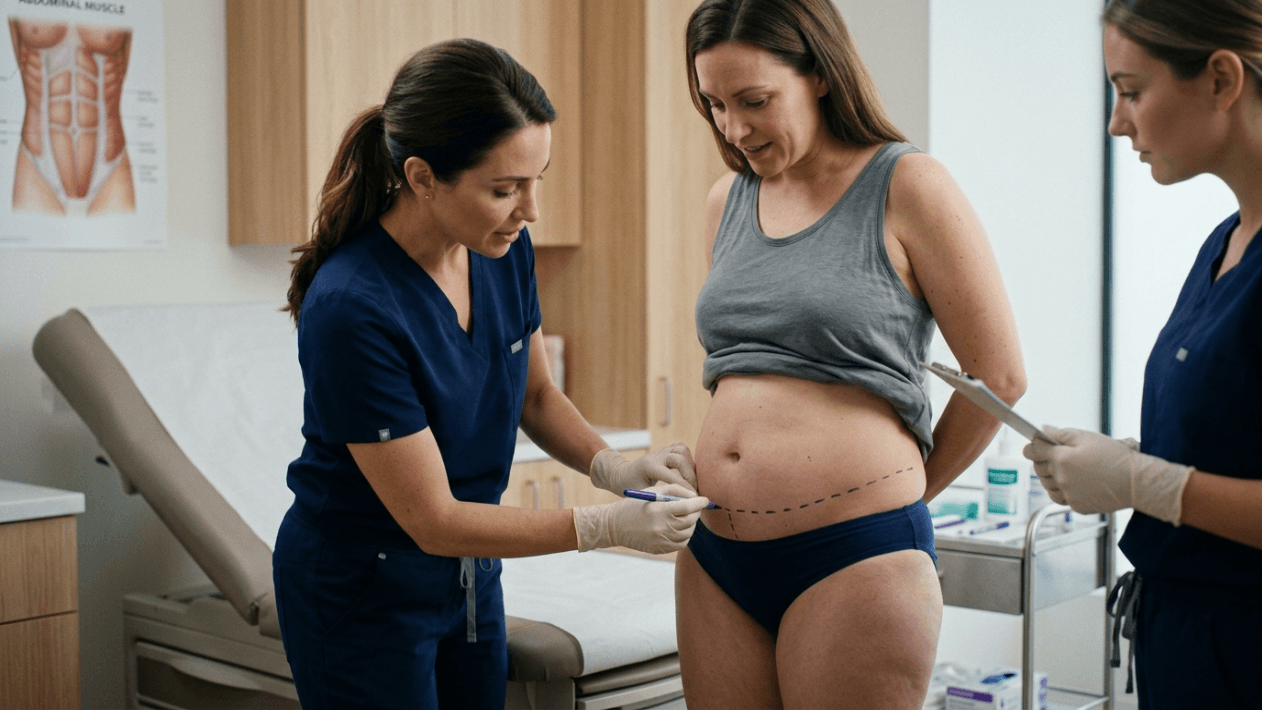

Did you know that up to 96% of bariatric surgery patients develop redundant skin severe enough to interfere with daily life, yet most of them choose the wrong contouring procedure for their anatomy? A landmark review published in the Journal of Clinical Medicine by Sadeghi and colleagues at the Cleveland Clinic documented this startling statistic, revealing that the sheer volume of post-weight-loss skin exceeds what a single-frontal procedure can address in most cases. The question is not whether you need skin removal. The real question is whether your skin laxity pattern demands a tummy tuck vs body lift decision—and choosing incorrectly can leave you with a flat abdomen framed by sagging sides and buttocks that look worse than before surgery.
By the end of this anatomical decision guide, you will possess a clear, physician-validated method for identifying your own skin laxity pattern—circumferential versus anterior—and matching it to the correct procedure. This tummy tuck vs body lift comparison eliminates the confusion that plagues post-bariatric and post-weight-loss patients, giving you the anatomical literacy to make a confident surgical choice with Dr. Sibel Atalay’s 29 years of body contouring expertise guiding every recommendation.
Why the Tummy Tuck vs Body Lift Decision Confuses So Many Patients
Most patients assume that any excess abdominal skin automatically calls for a tummy tuck. This assumption holds true when skin laxity concentrates on the front of your body. However, after massive weight loss—whether through bariatric surgery, GLP-1 medications, or disciplined lifestyle changes—skin often sags in a circumferential pattern that wraps entirely around your lower trunk. A tummy tuck, no matter how skillfully executed, addresses only the anterior surface. When the back, flanks, outer thighs, and buttocks also droop, the result resembles a tight shirt paired with sagging pants: one zone improved, three zones neglected.
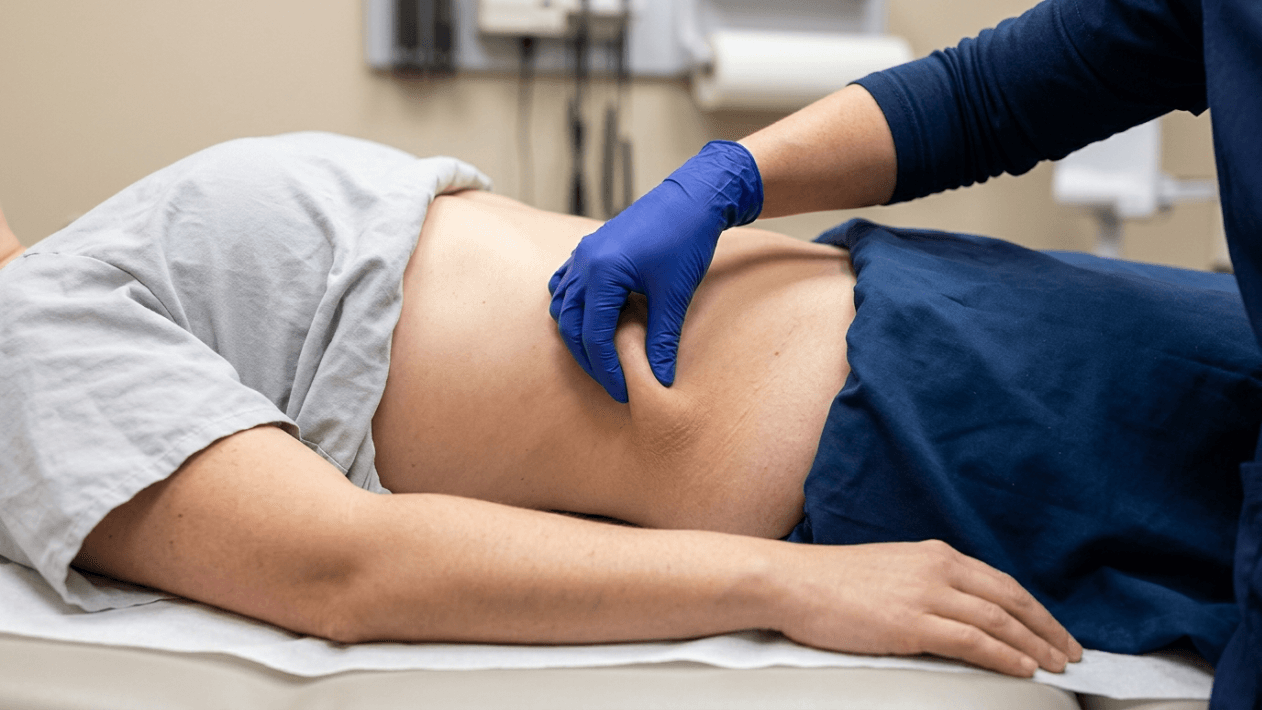
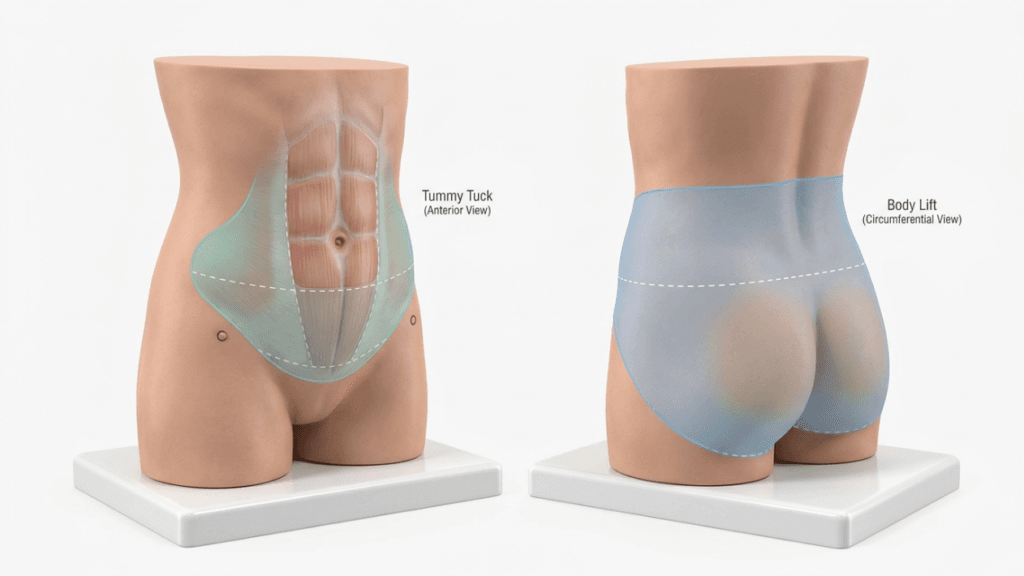
This mismatch occurs because the two procedures differ fundamentally in their surgical axis. A tummy tuck pulls skin downward from the ribcage toward the pubis—a vertical vector on the front wall. A body lift, technically called a belt lipectomy or lower body lift, pulls skin in a circumferential direction around the entire torso like a belt. The direction of pull must match the direction of laxity. When you understand this single principle, the entire tummy tuck vs body lift decision resolves itself through simple proprioception: grasp the loose skin on your sides and lower back. If it slides downward, your laxity pattern is circumferential.
Understanding Circumferential vs Anterior Skin Excess
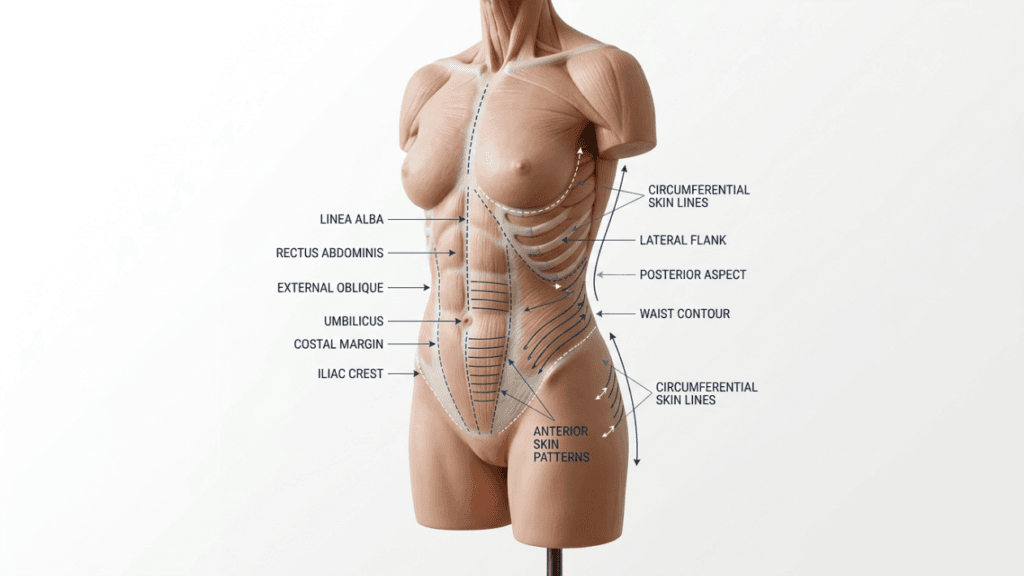
Skin laxity after weight loss follows predictable anatomical patterns determined by where fat accumulated most heavily and how long it persisted. Patients who carried their weight predominantly in the abdomen—common after pregnancy or moderate weight gain—develop anterior skin excess. The skin hangs over the pubic area, may cause rashes beneath the fold, and bothers the patient mainly when looking down at the belly. The flanks, lower back, and buttocks retain reasonable tone.
Conversely, patients who experienced massive weight loss—typically 100 pounds or more—develop circumferential skin laxity. Their skin sags around the entire lower trunk like a deflated balloon. The abdomen droops, the flanks accumulate loose tissue, the buttocks flatten and descend, and the outer thighs develop skin rolls. Sweating beneath the lateral folds creates chronic intertrigo. Clothing fits poorly across multiple zones, not just the front. This is the classic post-bariatric body contouring decision point.
The Pinch Test: A Self-Assessment for Circumferential Skin Laxity
Before your consultation, perform this simple self-assessment. Stand in front of a mirror and grasp the skin on your flanks—the area between your hip bone and lower ribs. Pull it forward. If the skin moves more than two centimeters toward your navel, your laxity extends beyond the anterior wall. Next, reach behind you and pinch the skin above your buttocks. If it gathers like a loose shirt, your posterior laxity confirms a circumferential pattern. Patients with multi-zone skin excess almost always discover that both zones demonstrate significant mobility, indicating the need for a body lift rather than an isolated abdominoplasty.

Defining Each Procedure: What a Tummy Tuck Actually Addresses
An abdominoplasty, commonly called a tummy tuck, removes excess skin and fat from the front of the abdomen while repairing diastasis recti—the separation between the left and right abdominal muscles. The incision runs horizontally between the hip bones, low enough to hide beneath most underwear. The surgeon lifts the skin upward, tightens the underlying muscles with permanent sutures, removes the hanging skin, and repositions the navel. The tightening vector runs vertically on the front wall. A tummy tuck does not address the flanks, lower back, buttocks, or thighs.
For patients with anterior-only laxity, this procedure delivers dramatic results. The stomach appears flatter, the waistline narrows, core strength improves after muscle plication, and chafing beneath the abdominal fold disappears. The scar, while permanent, sits low and becomes inconspicuous over time. Recovery typically spans two to four weeks before light activity resumes. According to the American Society of Plastic Surgeons data cited in the Cleveland Clinic review, abdominoplasty remains the most commonly sought body contouring procedure after weight loss—but that statistic alone does not mean it is the most appropriate procedure for every patient.
Defining the Body Lift: Circumferential Reshaping Explained
A lower body lift, also known as a belt lipectomy, extends the tummy tuck incision all the way around the torso. The procedure removes a wide belt of excess skin and fat from the abdomen, flanks, lower back, and upper buttocks. Because the incision circles the body, the surgeon can pull tissue inward from every direction simultaneously—tightening the front, narrowing the sides, and lifting the buttocks and outer thighs in one surgical session.
The body lift accomplishes three critical improvements that a tummy tuck cannot achieve. First, it lifts flattened, sagging buttocks by removing the extra tissue above them and repositioning the remaining tissue upward. Second, it tightens lateral skin rolls on the flanks and outer thighs that remain untouched during an abdominoplasty. Third, it eliminates posterior skin overhang on the lower back, which often causes intertrigo and hygiene problems that patients endure for years without realizing a surgical solution exists.
Mp. Op. Dr. Sibel Atalay has performed both procedures extensively during her 29-year career, and she emphasizes that the body lift is not simply a larger tummy tuck—it is a fundamentally different operation with a different pulling axis, different scar architecture, and different aesthetic goals. Patients should understand this distinction clearly before committing to either procedure. You can review her certifications and training credentials to confirm her expertise in post-bariatric contouring.

Tummy Tuck vs Body Lift: Direct Procedural Comparison
The table below contrasts the two procedures across every clinically relevant dimension. Study each row carefully, because your personal anatomy determines which column describes your surgical future.
| Dimension | Tummy Tuck (Abdominoplasty) | Body Lift (Belt Lipectomy) |
|---|---|---|
| Skin Laxity Pattern | Anterior (front only) | Circumferential (front, flanks, back) |
| Pulling Vector | Caudal (downward on front wall) | Circumferential (inward from all directions) |
| Incision Length | Hip-to-hip (low abdomen) | Full circumference (around entire lower trunk) |
| Muscle Repair | Yes (diastasis recti plication) | Yes (anterior plication included) |
| Buttock Lifting | No | Yes |
| Flank Contouring | Minimal (some liposuction may help) | Significant (direct skin excision) |
| Outer Thigh Tightening | No | Yes (moderate improvement) |
| Back Roll Reduction | No | Yes (lower back directly addressed) |
| Surgery Duration | 2–4 hours | 4–7 hours |
| Recovery Time | 2–4 weeks (light activity) | 4–6 weeks (light activity) |
| Scar Position | Low abdomen (hidden under underwear) | Circumferential (hidden under belt-line clothing) |
| Typical Candidate | Post-pregnancy, aging, moderate weight loss | Post-bariatric, massive weight loss (100+ lbs) |
| Risk of Contour Mismatch | High if applied to circumferential laxity | Low (addresses all lower trunk zones) |
The Degree of Lower Body Ptosis: Why Buttock Position Matters
Mp. Ptosis refers to the downward displacement of tissue from its natural position. After massive weight loss, the buttocks frequently descend—a phenomenon called lower body ptosis. When you stand sideways in a mirror, observe whether your buttock crease sits noticeably lower than the midpoint of your thigh. If it does, a tummy tuck alone will tighten your abdomen while leaving sagging buttocks untouched, creating a jarring visual contrast between a firm front and a drooping backside.
The body lift specifically addresses this ptosis. By removing the belt of tissue above the buttocks and pulling the remaining tissue upward, the procedure repositions the buttock mounds to a more youthful, elevated position. This liftoff effect is one of the most dramatic aesthetic improvements patients notice after a body lift, and it simply cannot be achieved through any variation of the standard abdominoplasty technique.
Patients who visit our international health tourism program in Antalya often express surprise when Dr. Atalay evaluates their posterior laxity during consultation. Many arrived expecting a tummy tuck recommendation and depart understanding that their circumferential anatomy requires the broader scope of a body lift. This honest anatomical assessment prevents the contour mismatch that occurs when surgeons perform an abdominoplasty on a patient who truly needs circumferential correction.
Scar Position and Length: The Trade-off Nobody Explains
Every surgical procedure leaves a scar, but the architecture of that scar differs dramatically between these two operations. A tummy tuck scar runs horizontally between the hip bones, positioned low enough that standard underwear covers it completely. The scar measures roughly 25 to 35 centimeters depending on the extent of skin removed. Most patients find this acceptable, as the improvement in abdominal contour vastly outweighs the presence of a concealed line.
A body lift scar encircles the entire lower trunk at approximately the belt line. It traverses the abdomen, crosses the flanks, wraps around the back, and meets itself on the other side. The total length reaches 90 to 120 centimeters. While this sounds alarming, the scar sits within the bikini or belt line and fades substantially over 12 to 18 months. Surgeons design the incision path to follow natural body creases, which helps disguise it within the torso’s contour transitions.
Here is the insight most resources omit: the longer scar is not merely the price of a bigger procedure—it is the mechanism that makes circumferential correction possible. You cannot lift the buttocks, tighten the flanks, and smooth the back without incisions in those areas. The body lift scar represents the blueprint for 360-degree correction, and every centimeter of it serves a specific aesthetic purpose. Patients who choose a tummy tuck hoping to avoid a longer scar, when their anatomy demands circumferential treatment, often return within two years requesting revisional surgery—which produces additional scars without achieving the result a single body lift would have delivered.
The Post-Bariatric Body Contouring Decision Tree
Use the following decision tree to identify which procedure aligns with your anatomy. Read each question honestly, as self-deception during this assessment leads to disappointment after surgery.
Node 1: Is Your Skin Laxity Confined to the Front?
Stand naked in front of a full-length mirror. Observe your flanks and lower back without twisting. If the skin on your sides and back appears tight, with no folds or hanging tissue, your laxity pattern is anterior. Proceed to Node 2a. If you see loose skin, creases, or hanging tissue on the flanks, hips, or lower back, proceed to Node 2b.
Node 2a: Do You Have Diastasis Recti or Muscle Weakness?
Lie on your back and lift your head and shoulders slightly off the floor, as if beginning a crunch. Place your fingers vertically above your navel. If you feel a gap wider than two finger-widths between the abdominal muscles, you have diastasis recti. A full tummy tuck with muscle repair addresses this condition directly, restoring core integrity while removing the excess front skin. If no gap exists and your concern is purely skin, a mini tummy tuck or skin-only abdominoplasty may suffice, though a thorough in-person evaluation is essential.
Node 2b: Has Your Total Weight Loss Exceeded 100 Pounds?
Patients who have lost more than 100 pounds—whether through bariatric surgery, GLP-1 agonist medications, or sustained lifestyle change—almost universally develop circumferential skin laxity. The skin envelope around the entire lower trunk has stretched beyond its capacity to retract. A body lift becomes the anatomically appropriate choice. Choosing a tummy tuck at this stage addresses only one-quarter of the problem and creates the visual mismatch that plastic surgeons call the “flat front, sagging sides” deformity.
Node 3: Do You Experience Hygiene Issues on Multiple Trunk Zones?
Intertrigo, the painful inflammation caused by skin-on-skin friction in moist folds, commonly affects the area beneath the abdominal pannus. But post-bariatric patients also develop intertrigo beneath the flank rolls, in the lower back creases, and along the outer thigh folds. If you experience rashes, chafing, or skin breakdown in zones beyond the front abdomen, a body lift resolves these problems across the entire circumference. A tummy tuck resolves only the front fold.

Multi-Zone Skin Excess: What Happens When You Choose the Wrong Procedure
Consider a patient who lost 130 pounds after gastric bypass surgery. Her abdomen hangs, her flanks drape over her hips, and her buttocks have flattened against her posterior thighs. She requests a tummy tuck because she has heard the term more frequently, and the shorter scar appeals to her. The surgeon performs the abdominoplasty, and her front looks dramatically better—but now the visual contrast between her tightened abdomen and her untouched sagging flanks and buttocks makes the posterior laxity appear even more prominent. Clothes fit oddly. The abdomen sits flat while the sides pooch outward. She feels more self-conscious than before the operation.
This outcome is not hypothetical. Plastic surgery literature consistently documents that contour mismatch—improving one zone while neglecting adjacent zones—represents one of the most common sources of patient dissatisfaction after body contouring. The Cleveland Clinic review by Sadeghi and colleagues emphasizes that for patients with circumferential skin excess, comprehensive interventions such as a belt lipectomy deliver substantially better outcomes than isolated abdominoplasty. The lesson is clear: match the procedure to the pattern, not the popularity.
Recovery Differences: What Your Body Endures After Each Procedure
A tummy tuck requires approximately two to four weeks before patients return to light activities. You will stand slightly bent forward for the first few days as the abdominal skin adjusts to its new, tighter position. Walking short distances begins on the day of surgery or the following morning. Most patients drive again within two weeks and resume office work by the third week. Compression garments support healing for four to six weeks.
A body lift extends this timeline. Because the incision circles the trunk, mobility restrictions last longer—typically four to six weeks before light activities feel manageable. Patients who undergo body lifts often spend their first two weeks in a slightly flexed posture, with gradual straightening as posterior skin tension decreases. Drain tubes remain in place for 10 to 21 days. Full unrestricted activity usually requires eight to twelve weeks.
Patients who travel through international health tourism for either procedure receive comprehensive postoperative support, including VIP airport transfers, accompaniment coordination, and detailed follow-up care. The recovery environment in Antalya offers the dual advantage of world-class medical supervision and a restful Mediterranean climate that supports healing—something patients from colder northern climates particularly appreciate during their convalescence.
Risk Profiles: How the Two Procedures Compare in Safety
Both procedures carry standard surgical risks including bleeding, infection, poor wound healing, and blood clots. However, the body lift’s longer incision and greater tissue disruption increase the statistical likelihood of wound complications—particularly at the posterior midline where tension concentrates. Seroma formation, the collection of fluid beneath the skin flaps, also occurs more frequently after body lifts due to the extensive undermining required across the trunk.
A tummy tuck’s complication rate, while higher than many cosmetic procedures, remains lower than that of a body lift. Specific tummy tuck risks include umbilical necrosis—poor blood supply to the repositioned navel—and persistent lower abdominal numbness. Body lift patients additionally face risks of delayed wound healing at the lateral and posterior closure points, where skin tension peaks.
Choosing a surgeon with extensive experience in post-bariatric contouring dramatically reduces these risks. Dr. Sibel Atalay’s board certification and 29 years of surgical practice inform her meticulous technique, which includes progressive tension sutures and quilting stitches that minimize seroma formation and distribute wound tension evenly across the closure.

Candidacy Checklist: Who Should Choose Which Procedure in 2026
Review the following criteria to gauge which procedure suits your anatomy. Remember that only an in-person consultation with a board-certified plastic surgeon can confirm your candidacy, but these checkpoints give you a reliable starting point.
You Likely Need a Tummy Tuck If:
- Your excess skin hangs primarily on the front of your abdomen.
- Your flanks and lower back remain relatively tight with minimal sagging.
- Your weight loss resulted from pregnancy, aging, or moderate weight fluctuation (under 50 pounds).
- Mp. You have diastasis recti causing core weakness or postural problems.
- Your buttocks retain adequate shape and position without sagging.
You Likely Need a Body Lift If:
- You lost 100 pounds or more through bariatric surgery, GLP-1 medications, or lifestyle change.
- Loose skin wraps around your sides and lower back, not just your front.
- Your buttocks have flattened or descended significantly.
- You experience rashes or chafing in multiple trunk zones—abdomen, flanks, and back.
- Clothing fits poorly across the hips and flanks even when the abdomen feels acceptable.

Combining Procedures: When Both Operations Become Part of One Plan
Some patients benefit from staging their procedures rather than combining everything into a single operation. A body lift inherently includes the anterior component of a tummy tuck—muscle plication, skin removal, and navel repositioning—as part of its circumferential approach. Therefore, patients who need a body lift do not require a separate tummy tuck; the body lift already accomplishes everything the tummy tuck would have done, plus the lateral and posterior corrections.
However, body lift patients frequently need additional procedures to address zones beyond the lower trunk. Arm lifts, thigh lifts, breast lifts, and facelifts may all form part of a comprehensive post-bariatric contouring plan. Surgeons typically stage these procedures across multiple sessions to maintain safety limits on anesthesia duration. Dr. Atalay works with each patient to design a staged approach that maximizes results while respecting the body’s healing capacity. You can explore her full range of surgical services to understand how each component fits into a complete transformation timeline.
2026 Advances Affecting the Tummy Tuck vs Body Lift Decision
Several developments in 2026 refine how surgeons and patients approach this decision. GLP-1 receptor agonist medications have generated a new wave of patients experiencing massive weight loss without bariatric surgery. Many of these patients never imagined needing body contouring and feel unprepared for the circumferential skin laxity that follows their pharmaceutical success. They often default to requesting a tummy tuck simply because they are unfamiliar with the body lift option. Education about circumferential laxity patterns becomes critical for this emerging patient group.
Enhanced recovery protocols now reduce body lift hospitalization from the traditional three to five days to as few as one to two nights. Progressive tension suturing techniques, which Dr. Atalay employs routinely, eliminate the need for surgical drains in select cases and accelerate mobilization. Three-dimensional imaging allows patients to preview how each procedure would alter their silhouette, making the abstract choice between anterior and circumferential treatment plans visually concrete.

Your Step-by-Step Action Plan for Choosing the Right Procedure
Follow these actions to determine the correct procedure for your anatomy and move toward your consultation with confidence.
- Assess your laxity pattern using the pinch test. Grasp the skin on your flanks and lower back. Document whether the tissue slides easily or remains taut. Photograph yourself from front, side, and back angles in consistent lighting.
- Calculate your total weight loss. Determine the difference between your highest lifetime weight and your current stable weight. Losses exceeding 100 pounds strongly suggest circumferential laxity requiring a body lift.
- Identify hygiene problems across all zones. Note every area where skin-on-skin contact causes rashes, odor, or breakdown—front abdomen, flanks, back, and thighs. Multiple zones point toward circumferential correction.
- Evaluate your buttock position. Compare your current buttock contour to photographs from before your weight gain. Descended or flattened buttocks confirm posterior ptosis requiring a body lift’s upward pull.
- Schedule a consultation with a board-certified plastic surgeon. Bring your photographs, weight loss history, and a written list of every zone causing concern. Dr. Sibel Atalay offers detailed evaluations at her appointment page.
- Discuss staging options. If you need additional procedures beyond the lower trunk, ask your surgeon about a staged plan that distributes surgery across safe intervals.
- Commit to weight stability before surgery. Ensure your weight has remained stable for at least six months. Surgical results on unstable weight trajectories risk producing redundant skin once again.
Frequently Asked Questions About Tummy Tuck vs Body Lift
How do I know if my skin laxity is circumferential or just anterior?
Circumferential laxity means loose skin wraps around your entire lower trunk—abdomen, flanks, back, and buttocks. If you can pinch and gather skin easily on your sides and lower back, your pattern is circumferential. Anterior laxity confines itself to the front belly area, with tight skin on the sides and back. The pinch test described above gives you a reliable self-assessment before your consultation.
Why does a body lift cost more than a tummy tuck?
A body lift requires longer operative time, more extensive tissue dissection, additional surgical staff, and longer anesthesia—all of which increase costs. The circumferential scar also demands more meticulous closure technique. However, body lift patients avoid the cost of a later revisional surgery that often occurs when a tummy tuck fails to address circumferential laxity.
Can a body lift also repair separated abdominal muscles?
Yes. A body lift includes the entire anterior component of a tummy tuck, meaning diastasis recti repair and abdominal muscle plication happen during the same operation. You receive the front tightening plus the lateral and posterior corrections in a single session.
How long after bariatric surgery should I wait before getting a body lift?
Most surgeons recommend waiting 12 to 18 months after bariatric surgery until your weight stabilizes for at least six consecutive months. Operating too early risks removing skin that your body has not yet finished reshaping, which can compromise your result and require revisional procedures.
Will insurance cover any part of a body lift or tummy tuck?
Insurance rarely covers cosmetic procedures, but if you suffer functional problems such as chronic intertrigo, recurrent skin infections, or severe diastasis recti causing back pain, portions of your surgery may qualify for partial coverage. Document every medical issue with your primary care physician before consulting a surgeon.
What happens if I get a tummy tuck but actually needed a body lift?
You will likely develop contour mismatch—a tight flat abdomen bordered by sagging flanks, drooping buttocks, and loose back skin. This visual disharmony often makes posterior laxity appear more pronounced. Most patients in this situation seek a secondary body lift within two years, which adds cost, additional scarring, and recovery time.